
SaaS Launch Traffic: The 10-Week Plan That Lasts Past Day 3
SaaS launch traffic is a short spike, not a growth engine. Here is a 10-week plan to build an audience first and turn launch day into lasting signups.
 SharyphOct 9, 202619 min read
TL;DR: A SaaS launch sends a short spike: usually hundreds of visitors that fade by day three. Build an audience first, launch on a few surfaces, then capture signups within 72 hours. Judge results by activated users, not upvotes. Lasting traffic comes from search, AI answers, relaunches and a loop built into the product.
A maker posted a launch report in the Product Hunt forum three days after shipping. 110 upvotes. 323 visitors. 26 signups. Zero paying customers. They finished #13 for the day, and by day three, Product Hunt referrals had fallen to zero.
That's what SaaS launch traffic looks like for most of us. Not a flood. A short burst, then silence.
You might be thinking: so launching doesn't work? It does, just not the way the headlines say. The launches with the best documented results treated launch day as the place an audience gets cashed in, not the place one gets built.
I've seen this from the other side. AI Offer Crafter was my first product, and I launched it to an audience, which most makers don't have. That gap is why I built Traffiklist, and I shared that first launch on Substack.
This is the 10-week plan I'd run if I were launching a SaaS tomorrow with a small audience and a small budget:
- Weeks -10 to -4: build the audience. DMs, a waitlist, building in public, a small beta group.
- Weeks -4 to -1: get ready. A tryable product, a page that converts, a day-of schedule.
- Launch week: amplify. Product Hunt, Show HN, your list, your socials.
- Weeks +1 to +12: compound. Capture signups, get cited by AI answers, relaunch, build a loop into the product.
This is for you if you're a bootstrapped or solo SaaS maker with a small audience, and you've launched before and wondered where the traffic went. It isn't for you if you have a PR budget and an agency, or you want a trick to rank #1 on launch day (there isn't a safe one).
How much traffic does a SaaS launch really bring?
A small SaaS launch usually brings hundreds of visitors, not thousands, and most are gone within three days. Third-party estimates put a non-Featured Product Hunt launch at 100 to 500 visitors and 1 to 15 signups. A front-page Show HN can send far more, but most posts never get there.
Five beliefs are worth clearing out before you plan anything.
Launch day is a spike, not an engine
Product Hunt's own Featuring Guidelines say editors choose launches on four criteria: Useful, Novel, High Craft and Creative. They also say engagement isn't everything.
The visitor numbers that get passed around come from third parties, so treat them as estimates. A 2025 guide from Awesome Directories puts a Featured launch at roughly 1,000 to 5,000 visitors and 10 to 150 signups, and says only about 10% of launches get Featured. That isn't official Product Hunt data, but it matches the forum report above.
Hacker News is similar. daily.dev's guide for developer tools says a front-page Show HN usually brings 5,000 to 30,000 visitors in 24 hours, while the median Show HN scores 2 points. Two outcomes, nothing in between.
Upvotes and traffic aren't signups
Upvotes are a compliment. Clicks are a fact. Signups are a bigger fact.
In a Startup Fortune community thread, one founder described a Hacker News front-page result as roughly 8,000 visits, around 40 signups and a couple of paying customers. Those numbers are self-reported, but they're the shape to expect.
Unbounce's Conversion Benchmark Report covers 41,000 landing pages. The all-industry median is 6.6%, the SaaS median is 3.8%, and you need 11.6% or higher to reach the top quartile. So 500 visitors at the SaaS median is about 19 signups: a decent day, not a business.
You can't safely game it
You can try, but the platforms are watching. The Show HN guidelines say it's for things people can try, not landing pages or sign-up pages, and Hacker News moderators advise against asking for upvotes.
Practitioner guides report that Product Hunt discounts votes from new accounts and coordinated patterns. That's an observation from guides, not documented policy, so weigh it accordingly. The upside of gaming it is a vanity number, and the downside is a buried launch or a banned account.
SEO isn't dead, and AI search won't save you
Ahrefs measured that AI Overviews cut position-1 click-through by 34.5% on the queries it studied. At the same time, AI answers are sending people who sign up. Tally says 43% of its new users now come from AI assistants, and I'll show you where that comes from in Step 7.
What should you do before launch day?
Spend the weeks before launch building a list of people who will try the product and tell you what they think. Send personal messages, start a waitlist, build in public and open a small beta group. Then let strangers use the product before they hand over an email.
Step 1: Build the audience (weeks -10 to -4)
Tally's founders had no big network. In their year-one write-up, they describe scanning Product Hunt and Twitter to build lists of hundreds of prospects, then cold-messaging them for feedback, often without success.
The people who replied became early users and ambassadors. Tally launched on Product Hunt in March 2021 with a community of 1,500 users and no marketing spend.
Do four things at once:
- Personal messages. Find people who upvoted or commented on similar products and message them. I'd aim for 20 to 50 a week. That's my suggestion, not a Tally number.
- A waitlist with a referral loop. Robinhood's waitlist reportedly reached nearly 1 million sign-ups before launch. Commission-free trading was new for its category, so treat a waitlist as a list-builder, not a miracle.
- Build in public. Publish progress every week. Tally has posted its revenue milestones for six years, and each post becomes its own distribution event.
- A small beta group. A Slack or Discord with a few dozen people who'll give honest comments on launch day. Supabase had about 80 alpha users when an early user posted it on Hacker News, according to co-founder Ant Wilson's launch write-up. The group was small. It was enough.
Here's a DM you can copy:
Hi [name], I saw you upvoted [similar product], so I figured you'd have a real opinion on this.
I'm building [product], which [one-sentence outcome]. You can try it without signing up: [link].
Would you tell me the first thing that confuses you? No pitch, I just want the honest read.
The common mistake is asking for upvotes in the DM. Ask for feedback. People who give feedback show up on launch day, and people who are asked for votes don't.
Keep the beta group small and specific. Tell people what you're testing this week, ask for one honest reaction, and reply to every message within a day. On launch day, skip the "please upvote" blast and send this:
We're live today: [link]. If you've used it, the most useful thing you can do is leave a real comment about what worked and what didn't.
If you haven't used it yet, try it for five minutes and tell me where you got stuck. I'm online all day.
Honest comments are what the platforms reward. A pile of one-word "great product!" comments from a group chat reads as exactly what it is.
Step 2: Make it tryable and fix your page (weeks -4 to -1)
Hacker News's rule is that Show HN is for things people can try. Tally's early growth leaned on the same idea: its founders wrote that you could start typing a form on the landing page without signing up. One small Product Hunt launch in that forum thread lost 297 visitors at the signup page.
- Add a no-signup demo, a sandbox or a guided tour with sample data.
- Benchmark your page against your own industry. Your target isn't 6.6%. It's the SaaS median of 3.8%, or 11.6% for the top quartile.
- Send launch traffic by email where you can. In Unbounce's data (cited by Sender), email-sourced landing pages convert best, at a 19.3% median.
The common mistake here is launching a waitlist-only page. It fails Hacker News's "can people try it" test, and Product Hunt wants a usable product too.
How do you run launch week?
Launch on Product Hunt first, then Show HN on a different day, and back both with your email list, Reddit and your own posts. Write the first comment before launch day, run the day from a written schedule and answer every comment. Ask for honest feedback, never upvotes.
Step 3: Pick your launch surfaces, in order
- Product Hunt. Launch at 12:01 a.m. Pacific, Tuesday to Thursday. Reply to every comment fast. Product Hunt's commenting guidelines say makers want to hear from real people, not a big comment count.
- Show HN, on a different day. Use a plain "Show HN:" title, a personal username and a backstory comment, and drop the marketing language. If you launched before, repost only if the new version is significantly different, and link the old thread. Okara's 2026 guide suggests Tuesday to Thursday, 8 to 11 a.m. Eastern.
- Reddit. The "9:1 rule" is only an informal expression of redditors' values. The rules that matter are each subreddit's own, so read the sidebar and disclose that it's yours.
- X, LinkedIn, Indie Hackers. Your own posts amplify everything else. own.page's launch post reached about 100,000 impressions, and its launch produced 2,000+ registrations in three weeks.
- Your email list. The highest-converting source, as above.
If you want the free-only version of this, I wrote a six-week free launch plan for side projects.
On Product Hunt, your first comment is what most visitors read, so draft it in advance:
Hi, I'm [name], the maker of [product].
I built it because [the specific problem you hit, in one or two sentences].
It does [one outcome], and you can try it without signing up: [link].
It's early, so I'd love to know: what's the first thing that felt confusing?
Write the Show HN backstory comment too. Hacker News readers want the story, the stack and the trade-offs, not the pitch. Say what it is, why you built it, what's rough about it and what feedback you want.
Match the surface to the feature: Supabase took its UI components to Product Hunt and front-end channels, and its file storage design to Hacker News.
Step 4: Run launch day from a schedule
Supabase's launch days run off a finely detailed schedule, with items like "7:55am Product Hunt goes live" and "8:00am blog post goes live." Launches get hectic, so it's easier not to think and just do.
Here's the version I'd use for a team of one:
- 12:01 a.m. PT: Go live on Product Hunt. Post your first comment with the backstory.
- First two hours: Reply to every comment. Message your beta group and ask for honest feedback.
- Morning in your audience's time zone: Email your list. Post on X, LinkedIn and Indie Hackers.
- Midday: Fix what breaks. Post one concrete update.
- Evening: Thank people. Screenshot your analytics, split by source.
- Next morning: Send the first nurture email (Step 6).
Even the textbook case lost the top spot. Tally's founders write that they held #1 for 23 hours, then lost it at the end and finished #4 of the day. They still doubled their user base, from 1,500 to 3,000 users.
How do you keep SaaS launch traffic after day three?
Capture signups in the first 72 hours, then build sources that keep paying: a few directories, comparison pages, content AI assistants can quote, scheduled relaunches and a loop inside the product. Tag every signup by source, so you can tell which surface produced real users instead of guessing.
Step 5: Add small, steady traffic sources
Curated directories and weekly boards give you backlinks, a permanent page and small referral streams. They also give AI crawlers more places to read about you. The evidence is thin and mostly from vendors, though.
One dev.to audit of 50+ AI directories found about 40% dead, about 25% now charging and only about 15% free and working. Skip the 100-directory spray, pick a few that match your niche, and track referral signups per source. My free 90-day backlink plan covers that side in more detail.
Yes, I built Traffiklist, so weigh that accordingly. It's a weekly launch board for indie and bootstrapped makers. You submit free and get a permanent product page, tracked clicks by source on the same dashboard as paid listings, and a do-follow backlink once your listing has 3 upvotes and a verified badge.
To go live on the free plan, you upvote 5 other products first. See this week's launches to judge it yourself.
Here's the honest trade-off. The audience is makers, so if your buyers aren't makers, the board is a backlink and proof of life, not a customer channel. I can't promise you customers, rankings or a number of clicks.
If you want a guaranteed spot instead of a lottery ticket, Featured gives you a pinned place in the top 5 of your launch week and a slot in that week's newsletter to 18,000+ subscribers. It's a one-time purchase, and there are no paid votes, ever. Why I built Traffiklist has the longer story.
Two paid options are worth knowing about.
AppSumo's partner terms say partners get 95% of revenue from new buyers they bring, paid Net 60. Lemlist made $161,896 gross in two weeks but kept about 30% after AppSumo's cut, and took on 3,000+ lifetime customers to support, per The Bootstrapped Founder. Use a lifetime deal only if you can handle the support wave.
BetaList's support page now says all submissions are paid, so I'd ignore the case numbers from 2016 to 2020.
Step 6: Capture the spike in the first 72 hours
Product Hunt referrals in that forum report were gone by day three, so the capture plan has to exist before launch day.
- Add an email capture on the thank-you and onboarding screens.
- Write a short nurture sequence for launch-week signups. Email 1 goes out the next morning.
- Retarget launch visitors for seven days. Flowjam's guide suggests this for Product Hunt traffic.
- Tag every signup by referral source.
Then measure the launch as a cohort. For each surface (Product Hunt, Show HN, your list, each directory, each social post), write down five numbers:
- Visitors sent
- Signups from those visitors
- Signup rate, compared with your 3.8% benchmark
- Users who reached your first "aha" action within seven days
- Users still active at day 30
Also watch branded search (people typing your name into Google) and new backlinks in the weeks after. Hacker News often pays off in feedback, credibility and a durable backlink more than in revenue, unless your buyers are developers.
This is the part Traffiklist's dashboard is built for, and it's why I'm stubborn about clicks. A number you can't trace to a source is a story, not a result.
The common mistake is judging the launch by upvotes on day one. Judge it by activated users at day 30. One HN founder in that Startup Fortune thread found that after counting the time spent babysitting the launch, the cost per customer was worse than their paid channels.
Step 7: Compound with search and AI answers
This is where launch traffic turns into lasting traffic.
- Comparison and alternative pages. "[Competitor] alternative" and "X vs Y" pages catch people close to a decision. They also suit AI answers, which quote structured, opinionated content. Build them honestly, with real trade-offs and pricing.
- Integration pages. Zapier is the standard case, with a page for each app and app-to-app combo. The risk is real, though: in March 2024, Google introduced a scaled content abuse policy covering pages generated mainly to manipulate rankings. Programmatic pages are safe only when each one carries real, distinct data.
- Answer-first writing. Under every question-style heading, answer in the first sentence or two, then expand.
Know the AI numbers. Tally says, in its September 2026 update, that 43% of new users now discover it through assistants like ChatGPT, Claude, Gemini and Perplexity. Tally is a form builder with 2.5 million users, so your numbers will be smaller.
On Ahrefs' own site, AI visitors were 0.5% of traffic but 12.1% of signups, per Patrick Stox in June 2025. That's one company's data, and a 2025 academic study found ChatGPT referrals converted worse than Google for e-commerce sites.
Get mentioned where AI models read: directories, comparison pages, Reddit threads, docs and reviews. Then check your analytics for AI referrers every month. Tally also says it doesn't control this channel, and a model update could reshuffle recommendations overnight.
Step 8: Relaunch on a schedule
Supabase has run Launch Weeks since March 2021, when it shipped 7 major features in a week. In a First Round interview, CEO Paul Copplestone said they kept seeing 20% bumps each time they ran a launch.
Ant Wilson's write-up explains why. Supabase ships features early, announces them in a monthly update, then does the full write-ups and big marketing during Launch Week. You can launch the same feature many times and still reach people who forgot, ignored or missed it before.
Pick a date about 90 days out, collect what you've already shipped and launch it again in a bundle. On Product Hunt, relaunch only with a substantial new version. If you plan press, book it early: Supabase says press needs arranging up to three weeks before launch.
Step 9: Build a loop into the product
The traffic that costs nothing is the traffic your product creates. Tally's forms carry a "Made with Tally" badge. Someone fills one out, sees the badge and signs up.
Tally says about 1% of those signups eventually upgrade, and in year one it listed the badge as one of its top five acquisition channels.
Pick one loop that fits your product: a "made with" badge, a shareable output, a referral reward or an integration listing. Tally integrates with Zapier and Make instead of building every feature itself, and every integration page and marketplace listing is a permanent discovery surface you build once.
Start small. A loop that ships in a week beats a perfect one that ships in a quarter. Then check, a month later, how many signups it sent.
What do realistic launch numbers look like?
Realistic launch numbers are modest: hundreds of visitors, a few dozen signups and usually no paying customers on day one. The best documented outcomes came from a list built before launch and repeated relaunches. Three data points follow, in order of how much I'd trust them.
- Tally. #4 of the day, 1,500 to 3,000 users after the launch, from a base built through personal outreach. Six years later it reports $6M ARR and 2.5 million users with a team of 10.
- Supabase. An accidental Hacker News launch after changing its tagline to "Open-source Firebase alternative," then recurring Launch Weeks.
- The small launch. 110 upvotes, 323 visitors, 26 signups, 0 paid. The most common outcome, and the one nobody posts.
Here's what a real launch looks like in the dashboard. This is the click-by-source panel for AI Offer Crafter, my own listing on Traffiklist:
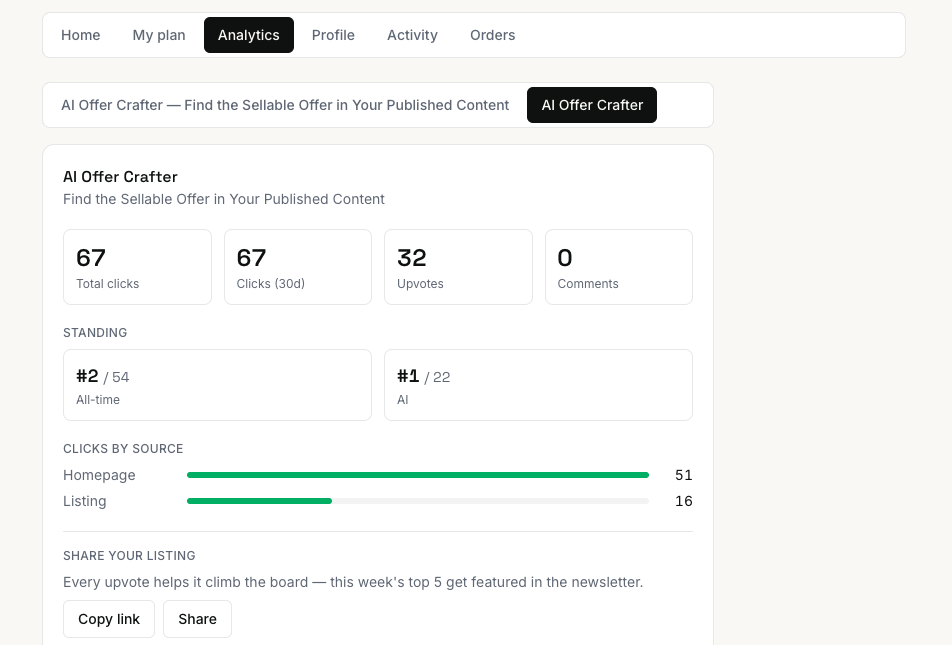
Every number is traceable to a source. That's the difference between a result and a story.
When to pay for traffic
Mostly, not yet. Paid ads at launch mostly cost money to learn. Here are the benchmarks so you know what you'd be buying:
- Google Ads: average CPC of $5.42 in WordStream's 2026 benchmarks of 13,000+ US campaigns (WordStream)
- LinkedIn Ads: CPC of $9.39 and CPM of $63.19 across 138 B2B advertisers (Metadata.io)
- Cold email: 3.43% average reply rate, 5.5% in the top quartile (Instantly's 2026 report)
Use paid for retargeting launch visitors and testing messages. Scale it only once you know your activation rate and payback period.
Frequently asked questions
How much traffic should I expect from a SaaS launch?
For a small launch, hundreds of visitors, not thousands. Third-party estimates put non-Featured Product Hunt launches at about 100 to 500 visitors, and a front-page Show HN at 5,000 to 30,000 in 24 hours. Most launches don't reach either, and traffic mostly fades within about three days.
Is Product Hunt still worth it in 2026?
Yes, as one surface among several, not as the plan. Editors now choose which launches get Featured, so a polished, useful product matters more than a push for votes. Treat it as a way to reach an audience you've already warmed up.
Can I launch a SaaS on Hacker News?
Yes, if people can try it. Show HN is for things people can use, not landing pages or waitlists. Post a plain title with a backstory comment, and expect feedback and credibility first, signups second.
Do directory backlinks help SEO or AI search?
They can help, and the evidence is mostly from vendors who sell directory submissions. Directories give you backlinks and more places for AI crawlers to read about you. Choose a few active, relevant ones, and track the signups each one sends.
How many times can I relaunch?
As often as you have something real to show. Supabase has run Launch Weeks since 2021 and says each relaunch reaches people who missed the last one. On Product Hunt, relaunch only with a meaningful update.
What conversion rate should I aim for?
Benchmark against your own industry. The SaaS landing page median is 3.8%, and 11.6% or higher puts you in the top quartile (Unbounce, 41,000 pages). Email traffic converts best, at a 19.3% median.
Key takeaways
- Build the list first. Message 20 to 50 ideal users a week for ten weeks before you launch.
- Make it tryable. Add a no-signup demo, and benchmark your page against the 3.8% SaaS median.
- Plan launch day and the 72 hours after. Write the schedule, the first comment and the capture plan before you go live.
- Measure by source and by day 30. Track visitors, signups and active users per surface, not upvotes.
- Compound the spike. Publish comparison pages, get mentioned where AI models read, relaunch in about 90 days and ship one product loop.
What to do next
Pick the step that fits where you are:
- Read. Start with Step 1 and write your list of 20 people today.
- Try it. Run Step 2 on your own landing page this week.
- Submit. Submit your product, free and see exactly how many people clicked.
- Upgrade, if you want to. See the Featured plans if you'd rather have a guaranteed spot than a lottery ticket.
Stop guessing whether anyone saw it. Hit reply and tell me what you're building. I read every one.
Sharyph
P.S. Updated October 2026. If this helped, send it to one maker who just launched into silence.
More from the blog
 Guides
Launch a Side Project for Free in 2026: A 6-Week Plan
Launch a side project for free in 2026: a six-week sequence covering the channels that still work, what now costs links or time, and realistic traffic.
Oct 5, 2026 · 14 min read
 Guides
Market a New App Without Ads: The 2026 90-Day Playbook
How to market a new app without ads: a 90-day plan covering audience, communities, AI search, directories and referral loops, backed by 2026 data.
Oct 5, 2026 · 30 min read