
New Website Backlinks: A Free 90-Day Plan (No Budget)
New website backlinks without paying for any: a free 90-day plan covering what to build, which links to earn, what to skip and how long it takes.
 SharyphOct 8, 202625 min read
TL;DR: New website backlinks come from one page worth linking to, a few dozen relevant links from your network, expert quotes and honest outreach, and patience. Expect 3 to 6 months before long-tail terms move. Skip bought links, bulk directories and PBNs, and track referring domains, not raw link counts.
You shipped. You hit publish, opened Google Search Console, and watched a flat line.
Then you searched for how to get backlinks for a new website and found two piles of advice. Pile one: pay someone $50 for 500 links. Pile two: a 40-step agency process that assumes you have a budget, a team and an audience.
Here's a number that should calm you down. Backlinko analysed 11.8 million Google results and found that about 95% of pages have zero backlinks (updated April 2025). Ahrefs looked at roughly a billion pages in 2021 and found that 66.31% have none.
So being ahead of most of the web is easy. Ranking for something competitive is the hard part, and that's where most new sites get stuck.
Here's the reframe. For a new site, the first 15 to 40 relevant links and a handful of real mentions do more than the next 300. Links are a trust threshold now, not a volume game.
You don't need to buy them. You need a page worth linking to, and a boring, repeatable way to put it in front of the right people.
This post is that way.
This is for you if:
- Your site or product is new and has almost no links
- You have a small budget (or none) and more time than money
- You're a solo maker, a bootstrapped founder or a no-code builder
- You want a plan, not a list of 50 tactics
This isn't for you if you're an agency or a funded team with a PR budget. I'll show what paid links cost later, but only so you can see what you're not paying for.
❌ Why do most new website backlink plans fail?
Most plans fail because they chase link volume instead of trust. Five common beliefs cost new sites months: that you need hundreds of links, that cheap packages are a shortcut, that domain rating is everything, that nofollow links are worthless, and that rankings arrive in weeks. Each has data against it.
Myth 1: "I need hundreds of links"
You probably don't. At Pubcon in September 2023, Google's Gary Illyes said links aren't a top-three ranking factor and that "it is possible to rank without links." In April 2024, at SERP Conf, he went further and said Google needs very few links to rank pages, though he later said he shouldn't have put it that way.
I wouldn't read that as "links don't matter". Ahrefs' January 2025 study of 1,000,000 SERPs found that links matter less overall, but more for high-volume and local queries. Those are exactly the searches new sites like to chase.
The honest summary: links still matter, mostly as a trust and discovery signal. The first dozen relevant ones matter far more than the next hundred.
Myth 2: "Cheap link packages are a shortcut"
They're a trap. BuzzStream's 2026 analysis classed 98% of guest-post marketplace sites as low quality (domain rating under 40 and under 10,000 monthly organic visits).
Google's spam policies list buying or selling links for ranking purposes, excessive link exchanges, automated link creation and low-quality directory or bookmark links. When Google's systems neutralise spammy links, the ranking benefit they had generated is lost, and Google says it cannot be regained.
A new domain has no trust buffer. Spending $50 on links that get neutralised leaves you with nothing.
Myth 3: "Domain rating is everything"
A site's DR or DA is a vendor's estimate, not something Google uses. In Editorial.link's March 2026 survey of 518 SEOs, 67.2% flagged low topical relevance as a red flag when judging a link, and 63.9% avoided sites with declining traffic.
A relevant niche blog with real readers usually beats an off-topic "write for us" site with a bigger number next to it.
Before you chase any link, ask two questions. Is the page about something related to mine? Does it get real visitors?
Myth 4: "Nofollow links are worthless"
Google has treated nofollow, sponsored and ugc as hints rather than commands since 2019 and 2020. And for AI search, Semrush's October 2025 study of 1,000 domains found that nofollow links carried nearly as much weight as followed ones for AI visibility.
A nofollow link from a publication your audience reads still sends visitors, still creates a mention and still helps people find you. Don't turn it down.
Myth 5: "I'll rank in a few weeks"
Probably not, and the data is blunt. Ahrefs' May 2025 study of newly published pages found that only 1.74% reached the top 10 within a year, down from 5.7% in 2017.
Of the pages that did get there, 40.82% did so within the first month. The average #1 page is about five years old.
New sites compete against pages with years of links and engagement. Plan for 3 to 6 months before long-tail terms move, and 6 to 12+ months for competitive ones. Start with low-competition topics where you can win.
🔗 How do you get backlinks for a new website?
Build one page worth linking to, then earn links in a set order: claim the easy relevant ones, ask your warm network, get expert quotes and run careful outreach, and measure referring domains monthly. Aim for 15 to 40 relevant referring domains in 90 days. It's a rough target, not a guarantee.
Here's the whole system in four moves:
- Build something linkable. One asset people have a reason to cite.
- Claim the easy, relevant links. Your network, your tools, reputable niche listings.
- Get mentioned. Expert quotes, podcasts, communities, honest outreach.
- Compound and measure. Reclaim mentions, track referring domains, double down on what worked.
Why the third move matters more than it used to: Ahrefs' 2025 study of 75,000 brands found that branded web mentions correlated 0.664 with brand visibility in Google's AI Overviews, against 0.218 for backlinks.
That's a correlation, not proof that mentions cause visibility. It's still a useful nudge: get your brand name in front of people and onto other sites, and links tend to follow.
Google's own position, in its guide to generative AI features (last updated July 2026), is that optimising for AI search is still SEO. The basics haven't changed. Make something useful, and get it cited by people who are credible.
Step 1: Make your site worth linking to
No one links to a thin site, so don't start with outreach. Start with one page that earns links on its own.
What to do. Pick one linkable asset. The three that work best for a new site:
- A statistics page for your niche. Bloggers and journalists cite these constantly, and many existing ones are out of date. Ahrefs has published its own case study on how stats pages attract links.
- A free tool or calculator. Pricing, ROI, conversion, anything small and useful. It can earn links for years.
- A small original dataset. A survey of 100 people in your niche, or a simple analysis of public data. One clear headline number plus 3 to 5 supporting findings.
Why it works. A link needs a reason. "Here's a good source for this number" is the easiest reason there is.
How to find the gap. Search your niche's main keyword, open the top results, and check which pages other sites link to a lot. Ahrefs Content Explorer or Semrush will show this, but the free version of Ahrefs and a few Google searches get you most of the way. Find the format that attracts links (stats, tool, study), then build something more current and more useful.
A starter structure for a stats page:
Title: [Topic] Statistics for [Year]: [N] Numbers Worth Knowing
Intro: 2 sentences. What this page is and when it was last updated.
Sections: 4-6 themes, each with 3-5 stats
For every stat: the number, the source name and year, a link to the source
Closing: "How we collected this" and a contact line for corrections
Common mistake. Scraping other stats pages and rewording them. If your page has no original number or no better sourcing, there's no reason for anyone to switch their link.
Also give the site basic credibility before you ask anyone to look. A real About page with a real person, a contact address and clear ownership goes a long way.
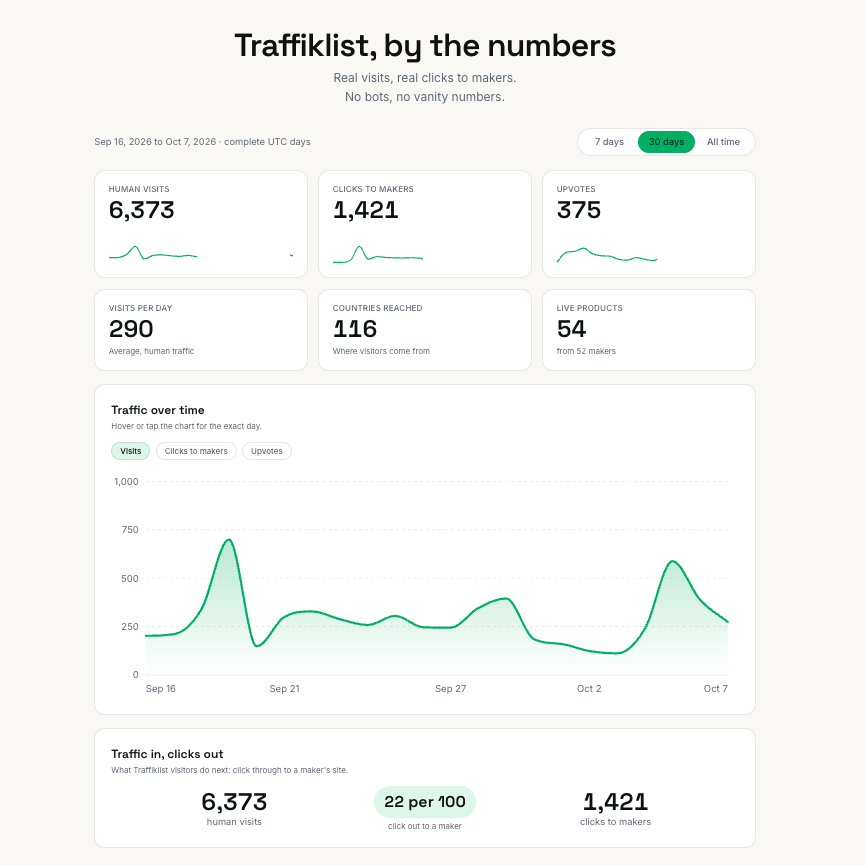
My own attempt at a linkable asset: Traffiklist's public stats page. It's a set of real numbers other people can cite, and I'm tracking whether anyone does.
Step 2: Claim the foundational links
These are the easy ones. They're mostly low-value on their own, but they set up your brand as a real entity and give crawlers a reason to find you.
What to do. Set up profiles on the places your audience and Google already trust:
- Google Business Profile, Bing Places and Apple Business Connect if you serve a local area
- LinkedIn, X, YouTube, GitHub and Crunchbase, as relevant to your product
- Reputable review and listing sites in your niche (G2, Capterra, Trustpilot if they fit)
- Trade associations, chambers of commerce and industry directories
Keep your name, description and URL identical everywhere.
Why it works. Consistent profiles help search engines and AI tools understand who you are. Most of these links are nofollow, and that's fine. You're building a footprint, not a ranking trick.
The directory rule. Google's spam policy explicitly lists low-quality directory and bookmark links. So skip any service that promises 500 submissions for $50, and skip anything you'd be embarrassed to show a customer. A good listing has real editorial standards, real users and a reason for your product to be there.
Where Traffiklist fits here. Yes, I built Traffiklist, so weigh that accordingly. It's one example of an honest listing: a weekly launch board where your product gets a permanent page, and where you can see how many people clicked, by source. On the free plan you can earn a do-follow backlink once your listing has 3 upvotes and carries the verified Traffiklist badge. You can see how it works on this week's launches. It's one link in a plan with many, not the plan itself.
If you haven't launched yet, my six-week launch plan covers the order I'd do it in.
Common mistake. Treating profiles as the strategy. They're setup work. Ten profiles don't make you authoritative, they just make you findable.
Step 3: Ask your warm network
This is the highest-quality, lowest-effort step, and most makers skip it because it feels awkward.
What to do. Make a list of everyone with a site who already knows you:
- Suppliers, partners and integrations you use
- Tools you pay for (many publish customer testimonials with a link)
- Clients and customers who have a site or a blog
- Communities, cohorts and alumni networks you belong to
- Friends who write about your niche
Only ask where a link is natural. A testimonial on a vendor's site, a "built with" mention or a resource list is natural. A random link on a page about something else isn't.
Why it works. These are relevant by default, they come from real people, and the ask is easy to say yes to. Watch the other direction too: Google lists partner pages built only for cross-linking as link spam. Don't swap links for the sake of it.
A copy-paste ask:
Subject: Quick favour: a link to [your page]?

Hi [Name],

I've been using [their tool / reading their blog] for [time] and
it's been genuinely useful for [specific thing].

I just published [your page], which covers [one-line description].
If it fits on your [resources page / the post about X], I'd be
grateful for a link. No pressure at all if it doesn't.

Either way, thanks for [specific thing they did].

[Name]
Common mistake. Asking for a link without saying why it would help their readers. One specific sentence about the fit does more than a paragraph of flattery.
Step 4: Use expert-sourcing platforms
This is the best free route to links from real publications, and it fits makers because you already have first-hand experience.
The short history, because it trips people up. HARO was shut down on December 9, 2024, after Cision had rebranded it as Connectively. Featured.com acquired the HARO brand and relaunched it as a free email digest on April 22, 2025. Its original founder, Peter Shankman, now runs Source of Sources (SOS).
Where to sign up:
- Qwoted. The Basic plan is free (2 pitches a month); paid plans start around $99 to $149 a month.
- Featured.com. Has a free tier and paid plans from about $29 a month.
- Source of Sources. Free, email-based and HARO-style.
- #JournoRequest on X, SourceBottle and Help a B2B Writer. Free and often more niche.
Pricing changes often, so check the vendors' pages before you pay for anything. You don't need to pay to start.
What to do. Pick 3 to 5 topics where you have real experience. Set alerts. Answer within hours, because speed matters, and keep each answer to 2 to 3 quotable sentences plus a line on who you are.
A sample answer:
Query: "What mistakes do first-time founders make when launching?"

My answer: The most common one I see is treating launch day
as the finish line. Most makers collect a few upvotes, then
go quiet for weeks. The ones who get traction treat launch as
the first of ten small distribution moves, and track which
source each visitor came from.

[Name], founder of [Product] ([URL]). Headshot: [link]
Why it works. Journalists want a quote from someone who did the thing. A solo founder with a real story is more useful to them than a generic expert.
Common mistake. Pasting AI-written boilerplate. Platforms are filtering for it, and journalists can tell. Say something only you could say.
Step 5: Do outreach that gets replies
Outreach works, but only if you do it properly. Here's what the numbers say.
The old benchmark. In 2019, Backlinko and Pitchbox analysed 12 million outreach emails and found an 8.5% average reply rate. Personalised subject lines added 30.5% to replies, and one follow-up lifted replies by 65.8%.
The newer one. More recent data is gloomier. Instantly's 2026 Cold Email Benchmark Report, which covers 2025, puts the average cold email reply rate at 3.43%, with the top quartile at 5.5% or more. Inbox providers now penalise unpersonalised bulk sending.
So plan for low single digits, and make every email earn its place. Sharp targeting beats volume.
Two templates that fit a new site.
Broken link. Find a page in your niche that links to a dead resource, and offer yours as a replacement:
Subject: Broken link on your [topic] guide

Hi [Name],

I was reading your [page title]. The section on [specific point]
was useful. The link to [dead resource] now returns a 404.

I recently published [your resource], which covers the same
thing with 2026 data. It might work as a replacement. Either
way, thanks for a great guide.

[Name, role, site]
Unlinked mention. After any press, podcast or quote, check whether the article actually links to you:
Subject: Thanks for mentioning [Brand]!

Hi [Name],

Thanks for including [Brand] in [article]. Would you mind
linking our name to [URL] so readers can find us easily?
Happy to share the piece with our audience either way.
The cadence. Day 0: first email. Day 3 or 4: follow-up with a new angle. Day 7 to 10: a short "closing the loop" note. Stop there, and always include an easy way to opt out.
Common mistake. Sending 500 emails with a template and a name merge. Send 50 good ones.
Step 6: Go where communities and AI tools look
Some of the most useful visibility for a new site doesn't come with a followed link at all.
Podcasts and interviews. Show notes usually link to the guest. A new founder with a specific story or a piece of data is an attractive guest for niche shows. Pitch one episode idea, not a general "I'd love to be on your show."
Communities. Reddit, Quora and niche forums mostly give nofollow or ugc links. Google recommends ugc for forum links and lists forum comment spam and optimised signature links as link spam. So the value isn't PageRank. It's referral traffic, brand mentions and, increasingly, AI citations.
The rules are simple. Answer the question properly. Disclose that you built the thing.
Link only when it's genuinely the best answer. Follow each community's self-promotion rules.
Listicles and reviews. Being included in "best X for Y" lists and review sites creates both a mention and a link. Ask politely, and make it easy by sending a short factual summary.
Where AI search is heading. Ahrefs found that 76% of AI Overview citations came from top-10 pages in July 2025, and about 38% in a March 2026 update. Ahrefs says part of that drop is down to better parsing, not just Google changing behaviour. In Ahrefs' August 2025 study, only about 12% of links cited by ChatGPT, Gemini and Copilot appeared in Google's top 10 for the same prompt, on average. Perplexity was the exception, at 28.6%.
The practical takeaway: ranking helps, but it isn't the only route to being cited. Being mentioned in several places helps too.
Common mistake. Dropping links in threads. It's ineffective, it's against most community rules, and it's explicitly listed as link spam.
Step 7: Track what matters (and ignore the rest)
What to track.
- Referring domains, not total backlinks. One link from each of ten sites beats ten links from one site.
- Relevance of each linking site.
- Rankings for your long-tail target keywords.
- Referral traffic from each link.
- Mentions, linked or not.
- AI citations, using Search Console's Generative AI performance report if you have it.
The free stack. Google Search Console for your own links (it shows a sample, and exports are capped at 1,000 rows). Ahrefs Free for verified sites. Google Alerts for brand, founder and product names. Hunter's free plan (50 credits a month) for finding emails. Qwoted Basic for expert queries. Total cost: $0.
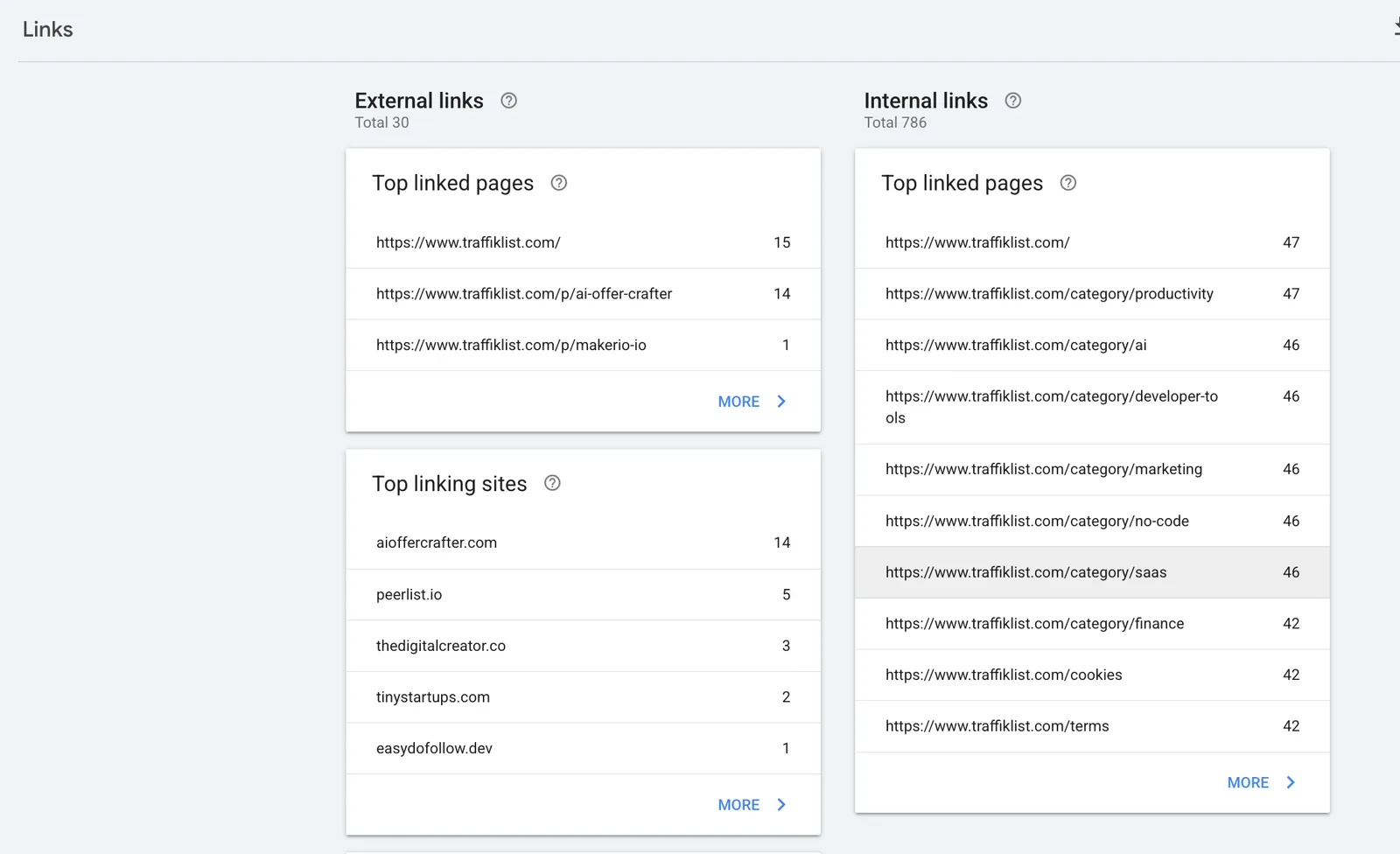
Google Search Console, Links report for traffiklist.com: 30 external links in total. The top linking sites are aioffercrafter.com (14 links), peerlist.io (5), thedigitalcreator.co (3), tinystartups.com (2) and easydofollow.dev (1). Two of those, aioffercrafter.com and thedigitalcreator.co, are my own sites, so 17 of the 30 links are self-links. Count the sites, not the links, because one site can account for most of the total.
If you want competitor gap analysis, one month of a paid tool (Ahrefs Lite or Semrush Pro, roughly $129 to $140) is enough. Cancel after you've exported your prospect list.
Check for unlinked mentions. After each quote, podcast or article, search for your brand name. Many mentions come without a link, and a polite email often fixes that. In Editorial.link's March 2026 survey, 80.9% of SEOs believed unlinked mentions affect rankings. I'd treat that as opinion, but even an unconverted mention has value.
When not to disavow. Google's John Mueller said in 2022 that disavowing random links a tool has flagged is not a good use of your time, and that the disavow tool is for links you paid for. A "toxic score" from a tool isn't a Google signal. A new site almost certainly has nothing to disavow.
What does paid link building cost, and what are you skipping?
Here's what the paid route looks like, so you know what the $0 route replaces.
- Editorial.link's March 2026 survey of 518 SEOs found they'd consider about $508.95 an acceptable price for one high-quality link.
- BuzzStream's 2025 digital PR survey (about 70 practitioners) puts the average at $597 per link.
- BuzzStream's guest-post pricing analysis (257,267 sites, updated June 2026) found guest posts cost about $295 direct from a site and about $461 through a vendor, on average. High-quality sites cost far more, about $3,130 through a vendor (BuzzStream).
Note the source bias: BuzzStream and Editorial.link both sell link-building tools or services, and the survey skews toward agencies. The figures are still useful as a ceiling. They also confirm a pattern across sources: good links cost hundreds of dollars each, and cheap links are cheap because they're low quality.
On a new site, you can skip most of that. My read of the research is that a founder who spends 5 to 10 hours a week on expert sourcing, one small data study a quarter and honest outreach can reasonably expect to earn a handful of quality referring domains per quarter for time alone. That's an estimate, not a measured result.
If you outsource, pay for campaigns, not per-link placements, and never pay for a followed link. Compensated links should carry rel="sponsored".
What does a 90-day backlink plan look like?
It runs in three phases. Days 1 to 30 set up tracking, one linkable asset, profiles and your warm network. Days 31 to 60 are outreach and your first small data campaign. Days 61 to 90 reclaim mentions and build a second asset. A realistic target is 15 to 40 relevant referring domains, with no guarantee.
Here's the whole plan on one timeline.
Days 1 to 30: foundation
- Verify Google Search Console and Bing Webmaster Tools, submit a sitemap and set up Ahrefs Free and Google Alerts.
- Publish 5 to 10 solid pages, including a real About page, and one linkable asset (Step 1).
- Set up your foundational profiles and 3 to 5 reputable niche listings (Step 2).
- Ask your warm network for 5 to 10 links (Step 3).
- Sign up for Qwoted Basic, Featured and Source of Sources, and answer 3 to 5 relevant queries a week (Step 4).
- List 3 to 5 competitors and build a prospect sheet of around 100 targets, sorted by tactic.
Days 31 to 60: outreach
- Send 50 to 100 personalised emails (broken links, resource pages) with up to two follow-ups (Step 5).
- Pitch two guest posts or podcast appearances a week, only to outlets your audience reads.
- Run your first mini data campaign: one survey or analysis with one headline stat, pitched to 30 to 50 targeted journalists.
- Become a helpful regular in one or two communities, without dropping links (Step 6).
- Add internal links from every new page to your linkable asset and key pages.
Days 61 to 90: compound
- Reclaim unlinked mentions and 301-redirect any links pointing to 404 pages on your own site.
- Build a second linkable asset, such as a free tool or a "State of [niche]" page.
- Check which tactics earned the most referring domains per hour, and do more of the top two.
- Measure referring domains, relevance, long-tail rankings, referral traffic, mentions and AI citations.
A realistic 90-day target: roughly 15 to 40 relevant referring domains, a few of them editorial or media. That's a rough target, not a study result, and it won't guarantee anything. Expect first long-tail rankings, not head-term wins.
✅ Checklist
✅ Search Console, Bing Webmaster Tools and Ahrefs Free set up
✅ Google Alerts running for brand, founder and product
✅ One linkable asset published (stats page, tool or dataset)
✅ About page with a real person and a contact address
✅ Foundational profiles live, with consistent name, description and URL
✅ 5 to 10 warm-network links requested
✅ Qwoted, Featured and Source of Sources accounts created
✅ Prospect sheet of about 100 targets built
✅ Outreach sent with personalised first lines and up to two follow-ups
✅ One mini data campaign pitched
✅ Unlinked mentions checked after every quote or podcast
✅ Referring domains tracked monthly (not raw backlinks)
❌ No bought links, no PBNs, no bulk directory submissions
❌ No exact-match anchor campaigns
❌ No disavow files unless you bought links or got a manual action
What does it look like in practice?
I'd rather show you than tell you. This is two weeks of data from a brand-new site, and I'm just getting started.
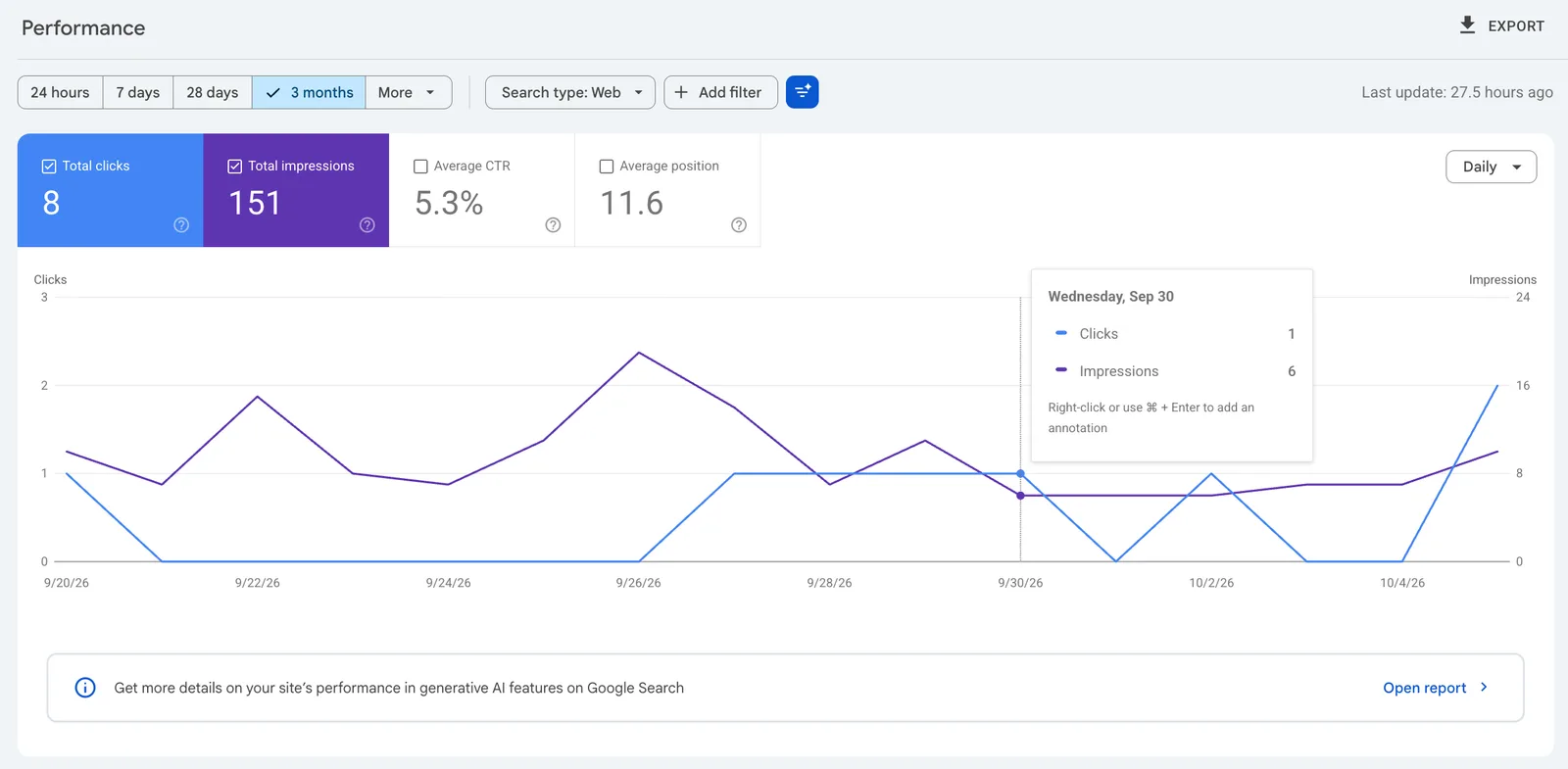
Google Search Console, Performance report for traffiklist.com, Sep 20 to Oct 5, 2026: 8 clicks, 151 impressions, a 5.3% click-through rate and an average position of 11.6.
It's a starting line, not a result. The average position comes from a very small sample, and I'd treat it that way. I'll add a later screenshot when there's more to show.
This is Traffiklist's own early data, not a case study.
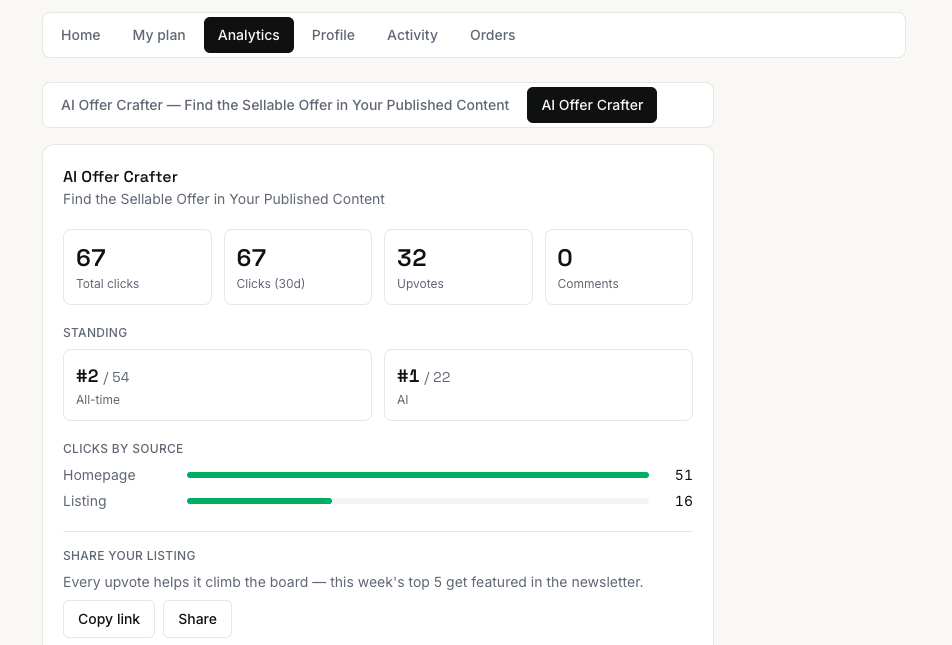
The click-by-source panel in a Traffiklist dashboard, for the AI Offer Crafter listing: 67 clicks in total, 51 from the homepage board and 16 from the product page.
If your numbers look slow at day 60, that's normal. Ahrefs' data says most new pages take months, and the pages that do break in often do it early.
A flat line at day 60 isn't a verdict. It's a signal to check whether you're building the right links.
Where does Traffiklist fit in a backlink plan?
Traffiklist is one listing in a plan with many: a weekly launch board where your product gets a permanent page and click tracking by source. On the free plan, you can earn a do-follow backlink after 3 upvotes and the verified badge. It isn't a ranking strategy, and one link won't move your rankings on its own.
Yes, I built Traffiklist, so weigh that accordingly.
Here's the honest version of what that's worth. Google's spam policy flags low-quality directories, so a listing is not a ranking strategy, and one link from any board won't move your rankings on its own. The reason I'd still list there is the proof: a visible page, a click count by source and a place where real makers see your product.
Use it as one link in the plan above, next to your network links, your expert quotes and your outreach. If it doesn't fit your product, skip it.
Frequently asked questions
How many backlinks does a new website need?
There's no universal number. The useful benchmark is the referring-domain count of the pages that already rank for your target keyword. Check the top five results, note each page's referring domains, and aim for the lower end of that range with more relevant links. For a brand-new site, a rough first goal is 15 to 40 relevant referring domains in 90 days.
How long does it take for backlinks to help?
Usually 3 to 6 months for long-tail terms and 6 to 12 months or more for competitive ones. Ahrefs found that only 1.74% of new pages reached the top 10 within a year, and the average #1 page is about five years old. Pages that do rank often get there fast, so early momentum is a good sign but a slow start isn't a verdict.
Do nofollow links help?
They can. Google treats nofollow, sponsored and ugc as hints, and Semrush found nofollow links carry nearly as much weight as followed ones for AI visibility. They also send referral traffic and create mentions. Don't turn down a nofollow link from a publication your audience reads.
Are directories bad for SEO?
Low-quality ones are. Google's spam policy lists low-quality directory and bookmark links, so skip mass-submission services. Reputable, editorially reviewed listings in your niche are fine, but treat them as setup work, not a ranking strategy. They're one link among many.
Should I disavow bad links?
Almost certainly not. Google's John Mueller has said that if you weren't buying links, you don't need to disavow. A toxic score from an SEO tool isn't a Google signal. Only consider it if you bought links in the past or you've received a manual action in Search Console.
Do backlinks help AI search citations?
Probably, but mentions seem to matter more. Ahrefs' 2025 study of 75,000 brands found branded web mentions correlated 0.664 with AI Overview visibility, against 0.218 for backlinks. That's a correlation, not proof of cause. Google's own guidance says optimising for AI search is still SEO, so the same work (useful content, credible mentions) helps in both.
Key takeaways
- Build one linkable asset first, such as a stats page, calculator or small dataset, before you ask anyone for a link.
- Earn links in order: your warm network, expert-quote platforms, then personalised outreach to a short, relevant list.
- Skip bought links, bulk directory submissions and PBNs, because Google can neutralise them and the benefit can't be regained.
- Track referring domains, relevance and referral traffic every month, not raw backlink counts.
- Plan for 3 to 6 months before long-tail terms move, and aim for 15 to 40 relevant referring domains in 90 days.
👉 What to do next
Pick the step that matches where you are.
- Read and plan. Block out an hour this week and write your Days 1 to 30 list. Start with the linkable asset.
- Try it. Look at how the weekly board works before you commit to anything, and check the click-by-source panel in the screenshot above.
- Submit. Submit your product, free and see how many people click.
- Add the badge. The Traffiklist badge on your site is what unlocks the do-follow link on the free plan.
- Upgrade. The Featured plans buy a pinned placement and a newsletter slot. They don't buy rankings, and I wouldn't treat them as an SEO purchase. You can read more about why I built Traffiklist if you're curious.
Hit reply and tell me what you're building. I read every one.
Sharyph
P.S. Updated October 2026. The data here moves fast (AI search especially), so I'll refresh this post when the numbers change. If it helped, send it to one maker who just launched. More playbooks are on the Traffiklist blog.