Startup Directories: Which Are Worth It? A $0 to $150 Triage
Startup directories rarely send traffic. Here's a 90-minute triage: 5 to 15 curated listings, a $0 to $150 budget, and a log that shows what worked.
 SharyphOct 20, 202622 min read
TL;DR: Most startup directories give you little you can measure, so list on 5 to 15 curated ones, run a single launch event, and spend $0 to $150. Review and comparison platforms like G2 and AlternativeTo can show up in AI answers. Mass submission doesn't help SEO. Log every listing so you know which ones worked.
One maker finished #13 out of 307 launches on Product Hunt. They wrote up the results three days later in the Product Hunt forum: 110 upvotes, 323 visitors, 26 signups and zero paying customers.
Product Hunt sent 68 of their 229 visitors on day one. On day three it sent none.
They had no social media followers when they launched, and they'd also submitted to 34 AI listing sites. They did what the internet told them to do. The result is a respectable day on paper and no paying customers.
I've been there from the other side. When I launched AI Offer Crafter, I had an audience and most makers don't.
Makers submit somewhere, collect a few upvotes and a badge, and never find out if anyone looked. The same silence I felt in 2020, in a different costume.
So I read Google's own spam rules, the published link audits, the AI-search research and the launch reports I could verify. Then I asked a better question than "are directories worth it?"
Which ones, for whom, and how would you know?
That's what this playbook answers. Everything below works even if you never use Traffiklist.
Are startup directories worth your time?
Startup directories pay off for B2B, AI and developer-tool makers who have named competitors and almost no referring domains. For a local or non-tech business they're mostly admin. Fit matters more than how many listings you submit, so test your fit before you submit anywhere.
Who is this for?
This is for you if:
- You're pre-launch or newly launched with close to zero referring domains
- You build B2B software and have named competitors
- You build AI or developer tools
- You're a solo or bootstrapped maker with no PR budget
This isn't for you if:
- You run a local or non-tech business (industry citation sites and Google Business Profile matter far more for you)
- You want to buy 800 directory submissions for $39.95
- You're looking for a traffic channel to replace real distribution
How far can you trust the numbers?
One note on the data before we start. A lot of the numbers floating around about directories come from directories, submission services and SEO-tool vendors who sell the thing they're measuring. I've flagged those where it matters, and I've left out figures I couldn't trace to a primary source.
Do startup directories actually send traffic?
Not in any numbers I could verify. I couldn't find a published, checkable traffic figure for a single startup directory. The cases I could confirm point the same way: one Product Hunt launch sent 68 visitors on day one and none by day three. Launch spikes tend to go to founders who bring their own audience.
Myth 1: More directories means more traffic
I couldn't find a single published, checkable traffic number for any startup directory. That's the first thing to know. The people who publish numbers are mostly the directories and the services that sell submissions.
What I could verify points one way. The maker in the opening submitted to 34 AI listing sites and had no paying customers three days after launch. And as the link audit under Myth 4 shows, AlternativeTo, SaaSHub and Indie Hackers set their outbound links to nofollow.
More listings means more admin. It doesn't mean more visitors you can prove.
Myth 2: Product Hunt is a traffic firehose
It used to be easier to get on the front page. It isn't anymore. Hunted.space's Product Hunt Pulse puts the share of launches that get "Featured" at 17% in 2024, 6% in 2025 and 4% so far in 2026.
Between 2020 and 2023 it was 26 to 41% a year.
The #13 launch from the opening shows the shape of it. Product Hunt sent that maker 68 visitors on day one, 20 on day two and none on day three.
The big numbers do exist. They mostly belong to founders who arrived with an audience.
Dub.co's #1 result followed building an email list of 25,000+ users.
Product Hunt rewards the audience you bring. It doesn't create one.
What does a week of tracked clicks look like?
Here's what Traffiklist's own tracking shows for one week. Week 41 had 20 launches and 455 validated clicks in their first seven days.
The homepage sent 239 of them, the newsletter 131 and product pages 85. The median free launch got 18.5 clicks.
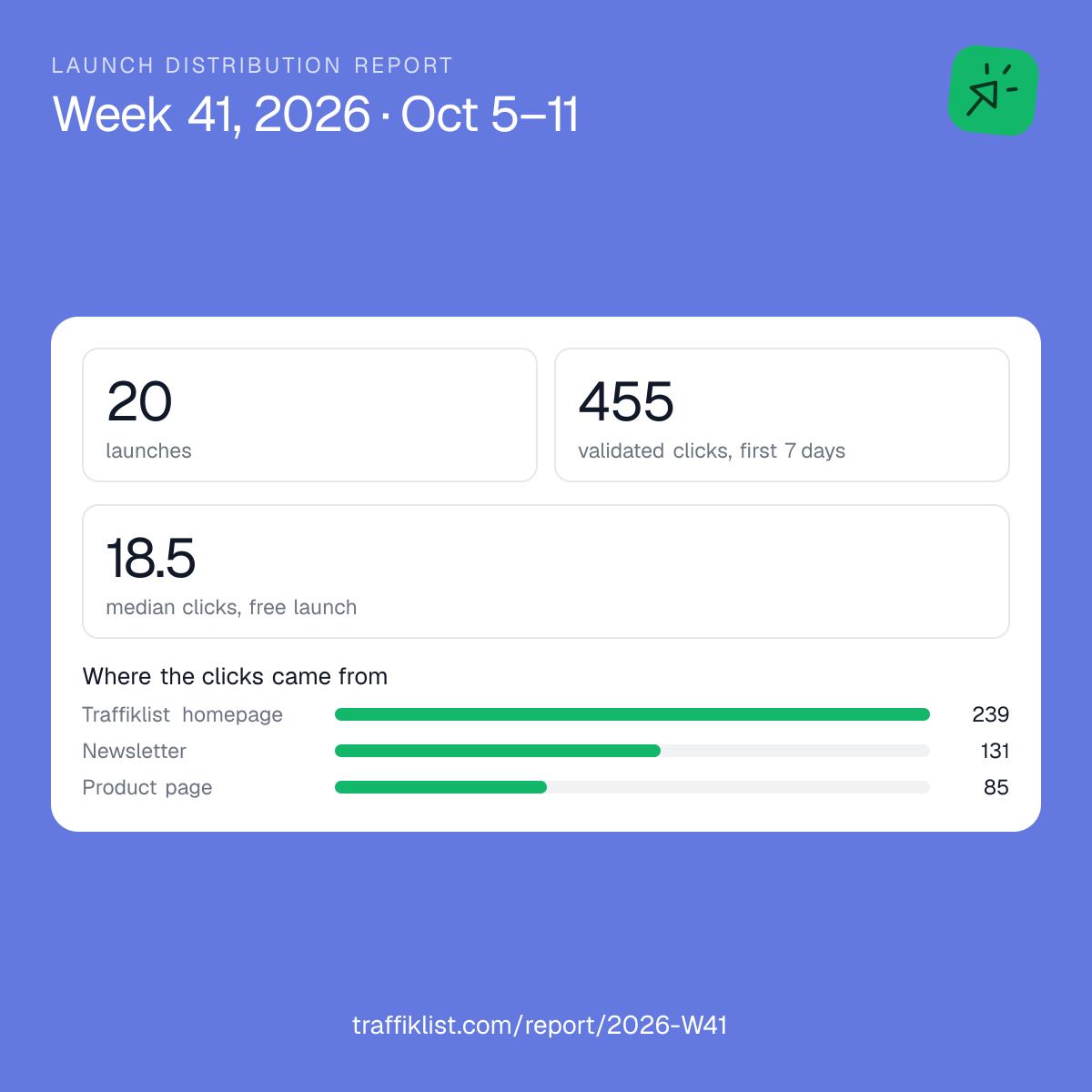
That's one board for one week. It's the kind of source-by-source count Step 7 asks you to keep for your own listings.
Do directory backlinks help SEO and AI search?
A few curated listings can help Google discover a new site, and a profile on a review platform like G2 can surface in AI answers. Hundreds of directory links won't lift rankings, and Google's spam policies name low-quality directory links as link spam. Check each link's attribute yourself before paying for anything.
Myth 3: Directory backlinks are free SEO
Google's spam policies list "low-quality directory or bookmark site links" as an example of link spam. I couldn't find any Google statement from 2022 to 2026 that endorses them.
There's a more useful nuance, though. John Mueller has said that if you weren't buying links you don't need to disavow, and that a "toxic score" from an SEO tool isn't a Google signal, as Search Engine Journal reported. So for most makers the realistic downside of junk directory links isn't a penalty.
It's wasted time. Manual actions remain possible for large-scale schemes, which is a good reason to stay away from bulk packages.
Here's the one legitimate SEO case. A brand-new domain with no links is hard for Google to discover, so a few real links from curated, indexed pages help Google find you.
My free route for that is backlinks for a new website.
A few listings can help you get discovered. Hundreds can't help you rank.
Myth 4: "Dofollow" claims are reliable
They aren't, and link attributes change without notice. A September 2026 audit of 20 platforms on HackerNoon checked the rel attribute on each platform's outbound link. Its author calls the table "a method demonstration, not a permanent reference".
- Product Hunt's "Visit website" link carries
rel="noreferrer noopener ugc" - AlternativeTo and Indie Hackers carry
nofollow noopener, and SaaSHub carriesnofollow - G2 says linking to your website is only available on upgraded profiles. A free profile has no link to your website, and "Visit Website" is a paid feature.
Since September 2019, Google treats nofollow, sponsored and ugc as hints rather than strict commands for ranking, and since March 2020 also for crawling and indexing. That makes "dofollow vs nofollow" less of a bright line than the SEO blogs suggest. It still tells you what the site is claiming about the link.
Don't pay for a link you haven't inspected. Step 4 below shows you how.
Myth 5: Any directory can win you AI citations
This is the newest myth, and it's half true, which makes it dangerous.
The real part: buyers do start with AI now. G2's own research suggests the shift is real on the buyer side. Its March 2026 survey of 1,076 buyers found 51% of B2B software buyers now start research with an AI chatbot more often than with Google.
That's G2 reporting on a world where G2 matters, so weigh it accordingly.
The correction: Ahrefs studied 75,000 brands in 2025 and found that branded web mentions correlate 0.664 with visibility in Google AI Overviews. Referring domains scored 0.295, and raw backlinks scored 0.218. That sample was filtered to brands with a Domain Rating above 40, so treat it as directional.
AI engines can only cite pages that aggregate reviews and comparisons. A G2 profile with real reviews, or an AlternativeTo page that lists you next to named competitors, can surface in "alternatives to X" answers. A listing on a low-traffic "submit your startup" site almost certainly can't.
How do you triage startup directories in 90 minutes?
Spend 90 minutes on four steps: run a fit test, set a budget and a bar, list on the review and comparison platforms, and check every link attribute yourself. Then add 5 to 10 niche directories, one launch event and a simple log. Total cost: $0 to $150, and you'll know which listings worked.
Here's the whole system in one list. Each step is expanded below.
- Fit: decide whether directories are worth your time at all
- Budget: set a money ceiling, a time cap and a pass/fail bar before you start
- Tier 1: list yourself on the review and comparison platforms (free, week one)
- Verify: check the link attribute on every live listing yourself
- Tier 2: pick 5 to 10 niche directories using a scorecard
- One launch: run a single launch event, not three
- Log: record every listing, and measure it properly
- Check AI: ask ChatGPT and Perplexity about your category once a month
- Reviews and the upgrade rule: earn reviews first, and pay for upgrades only after a listing proves itself
Budget about 90 minutes for steps 1 to 4 and a couple more hours spread across the rest. The point is to spend your time on the small number of listings that can plausibly matter.
Step 1: Run the fit test
What to do: Read both lists and be honest about which one describes you.
Directories are worth your time when:
- ✅ You're pre-launch or newly launched with zero referring domains
- ✅ You sell B2B software in a category with named competitors, where buyers and AI search run "alternatives to X" queries
- ✅ You build AI or developer tools whose audience genuinely browses AI directories or Hacker News
- ✅ You can bring your own audience to a launch day
They're not worth your time when:
- ❌ You want them to replace real distribution
- ❌ You're considering bulk packages of 100 to 1,000 directories
- ❌ You'd pay more than roughly $200 for a listing before you have revenue or a measurable funnel
- ❌ You run a local or non-tech business
Why it works: Fit matters more than any tactic. A B2B tool with three named competitors gets real value from comparison platforms. A local bakery gets almost nothing.
Example: Say you've built a scheduling tool for freelancers. You have named competitors, so you're a fit for G2, Capterra, AlternativeTo and SaaSHub. A developer CLI tool might skip G2 and lean on Hacker News and AI tool lists instead.
Common mistake: Treating "everyone is doing it" as a fit test.
Step 2: Set your budget and your bar before you start
What to do: Write down three numbers before you submit anything.
- A money ceiling. The sensible stack costs $0 to $150: free listings plus a few paid queue skips. One example from 2026 is AlternativeTo's $5 priority review (reported by SaaSCity, so check AlternativeTo's own page).
- A time cap. Decide upfront how many hours this whole exercise gets, and write it down before you start.
- A pass/fail bar for paid upgrades. My suggestion: before you spend $30 a month on any listing upgrade, it should already have sent at least 5 real visits or 1 signup a month for free.
Why it works: Pay-to-play is now the norm, so the temptation to spend scales faster than the evidence does.
Prices change fast, so check each platform's live pricing page before you pay for anything.
Common mistake: Deciding on a budget after you've already clicked "upgrade" on three listings.
Step 3: Tier 1, week one, free
What to do: Start with the platforms where listings can show up in buyer research and AI answers.
- G2 and Capterra (B2B software). A free profile may not link out to your website, so treat these as presence and reviews, not backlinks.
- AlternativeTo and SaaSHub. List yourself as an alternative to 3 to 5 named competitors. This is where "alternatives to X" searches land.
- Crunchbase. A basic, accurate profile.
- An Indie Hackers product page.
Why it works: These are the platforms where a listing can sit next to named competitors. A page like that is the kind of page that can get quoted in an AI answer.
A copy-paste listing template:
Name: [Product]
One-liner (under 80 characters): [What it does] for [who], without [the thing they hate]
Alternative to: [Competitor 1], [Competitor 2], [Competitor 3]
Category: [Pick the most specific one available]
Description (2 short paragraphs):
  1. The problem, in the words your customers use
  2. What your product does about it, plus one specific detail
Link: [Your URL with a UTM where the directory allows it]
Logo: [Square, high-res]
Screenshots: [2 to 3, real product, no mockups]
Common mistake: Pasting an AI-generated description without reading it. Check every live page after it publishes for a wrong logo, a bad description or another product's details.
Step 4: Verify the link attribute yourself (2 minutes)
What to do: For every listing, check what the link actually says.
- Open your live listing in Chrome.
- Right-click the link to your website and choose Inspect.
- Look at the highlighted line of HTML for a
relattribute. - Write down what you see:
nofollow,sponsored,ugc, or norelat all.
No rel attribute means a normal followed link. The others are hints that the site doesn't vouch for it for ranking purposes.
Why it works: Link attributes differ from platform to platform and change over time. Free G2 profiles may not link out at all.
Link attributes also change without notice. Two minutes of checking beats trusting a "best directories" list written by someone who sells submissions.
Common mistake: Paying for a "dofollow" upgrade without looking at the free listing first, or assuming a link you checked in March is the same link in October.
Step 5: Pick 5 to 10 niche directories with a scorecard
What to do: For every candidate beyond Tier 1, score it on six questions. If it fails more than one, skip it.
- Audience fit: do your actual customers browse here?
- Real traffic: what do Similarweb or Ahrefs estimates show? Treat them as estimates.
- Curation: is there a human editor, or does everything get in?
- Indexed listing pages: search
site:thatdirectory.com "your category"and see if the listing pages show up. - Verified link attribute: you checked it in Step 4.
- Presence in AI answers: does it appear when you ask ChatGPT or Perplexity about your category?
What to skip: anything with no visible traffic or editorial review, and any package promising 100 to 1,000 submissions. Done-for-you services include an eBay offer of "800 Dofollow Directory Submissions" for $39.95.
Large-volume services match the "automated programs or services" language in Google's spam policy.
Conditional links, treated honestly. Some directories only pass a dofollow link if you add their badge.
A badge-for-link arrangement can resemble the required-link patterns Google lists as spam. I'll come back to this when I get to Traffiklist, because mine works the same way.
Example: For an AI tool, a directory built around AI tools might pass the scorecard. Score it honestly, and expect even a good directory to be one source among several, not a channel.
Common mistake: Using a list of "100 best directories" as your shortlist. Those lists are mostly written by directories and submission services.
Step 6: Run one launch event, not three
What to do: Pick one launch event. Do it once, with preparation. I laid out how to sequence listings and launches in where to promote a SaaS.
Product Hunt makes sense if you have an audience and working onboarding. Before you commit, look at the #13 launch from the opening: a good day on the board and no paying customers three days later. If you don't have a list to bring, ask whether those hours are better spent elsewhere.
Show HN makes sense if your product is technical. A front-page Show HN can bring 5,000 to 30,000 visitors in 24 hours, according to daily.dev. But only 2.3% of submissions reached the front page in Q1 2026, by one vendor's analysis of 5,000 submissions.
Realistic expectations:
- One Product Hunt launch in a forum report: 323 visitors and 26 signups over three days
- A front-page Show HN: a big, short spike
- Neither guarantees a customer. The #13 launch above had 110 upvotes and no paying customers
Why one: Every launch event costs preparation, and the traffic is curiosity-driven and fades fast.
Common mistake: Launching before onboarding works. A spike of visitors hitting a broken signup flow is the most expensive way to find a bug.
Step 7: Log everything
What to do: Keep a simple log with one row per listing. Fields:
- Date submitted
- Listing URL
relattribute (from Step 4)- Cost
- Indexed? (check again after 2 to 4 weeks)
- Visits, signups and paid conversions attributed to it
Use UTM tags where the directory allows them. AlternativeTo strips them, so check server logs for those.
Why it works: Measurement is a bigger problem than most founders realise. Cookie banners and analytics filters undercount real visitors.
Self-clicks in incognito windows also inflate the numbers. If your analytics are wrong, your decisions are wrong.
Track signups and paid conversions per source, not upvotes. Upvotes are a compliment.
Clicks are a fact. Revenue is the real fact.
This is the step Traffiklist's dashboard does for free. Every link Traffiklist sends is a tracked redirect, so you see clicks by source (homepage, newsletter, badge, social). See how it works.
Common mistake: Logging upvotes and rankings because they're easy to see, then having nothing to show when you ask which listing paid off.
Step 8: Check AI answers monthly
What to do: Once a month, ask the AI tools your buyers use. Here's a prompt template:
What are the best alternatives to [Competitor]?
I'm looking for [your category] for [your audience]. Which tools should I compare, and what do reviewers say about each?
Run it in ChatGPT and Perplexity. Write down which sources they cite and whether you're mentioned. Repeat with two or three competitor names.
Why it works: The research found that branded web mentions correlate more strongly with AI visibility than raw backlinks. The only way to know whether any of your listings are feeding that is to look. The Ahrefs and G2 findings are correlational and partly vendor-produced, so your own check beats any study.
Common mistake: Checking once, finding nothing, and concluding it doesn't work. Check monthly, and look at which sites get cited, not just whether you appear.
Step 9: Reviews beat listings, and the upgrade rule
What to do: On G2 and Capterra, put effort into getting real reviews from real customers instead of polishing the profile. Review volume drives both in-platform ranking and the kind of presence AI engines pick up.
The upgrade rule: Don't pay for a listing upgrade until the free version has hit your bar from Step 2. If a listing hasn't sent 5 real visits or 1 signup in a month, a paid tier won't fix it.
Pay-to-play platforms exist to sell upgrades. Your log tells you which ones earned one.
Example: Say your Tier 1 listing on AlternativeTo sends 12 visits and 1 signup in a month. That's a listing worth a $5 priority review. A listing that sent nothing isn't worth $49 to find out again.
Common mistake: Paying for "featured" status on a listing nobody has ever clicked.
The checklist
Run through this once, then keep it for your next launch.
- ✅ I ran the fit test and I'm a B2B, AI or dev-tool maker with named competitors
- ✅ I set a money ceiling ($0 to $150), a time cap and a pass/fail bar before submitting
- ✅ Tier 1 is done: G2 and Capterra (if B2B), AlternativeTo, SaaSHub, Crunchbase, Indie Hackers
- ✅ I listed myself as an alternative to 3 to 5 named competitors
- ✅ I checked every live listing for a wrong logo, a bad description and the
relattribute - ✅ I scored every extra directory on the six-question scorecard and kept 5 to 10
- ✅ I picked one launch event and prepared onboarding first
- ✅ I'm logging date, URL,
rel, cost, indexation and results per source - ✅ I check "alternatives to [competitor]" in ChatGPT and Perplexity once a month
- ✅ I'm asking customers for reviews
- ❌ I'm not buying a bulk submission package
- ❌ I'm not paying for upgrades before the free listing proves itself
Where does Traffiklist fit?
Traffiklist is a weekly launch board for indie makers with a free plan that includes click tracking by source. It can give you a permanent page and a do-follow link, but not rankings, customers or traffic numbers. I built it, so weigh that accordingly, and judge it with the same triage as any other listing.
Yes, I built Traffiklist, so weigh that accordingly.
Traffiklist is a weekly launch board for indie and bootstrapped makers, which puts it in the same kind of listing you're weighing, so it should pass the same test I just gave you. You submit free, get a permanent product page, and to go live you upvote 5 other community products first. New listings show in random order for 48 hours, then upvotes from real accounts decide the order.
On the measurement problem from Step 7, the free plan includes full click tracking by source, the same dashboard as paid. So you see clicks by source instead of a vanity count.
Now the honest bit about links. You get a do-follow backlink once your listing has 3 upvotes and carries the Traffiklist badge. Earlier I said badge-for-link arrangements resemble patterns Google lists as spam.
I don't want to dodge that. Treat the link as a way for your listing to be found, and don't count on it to move your rankings. A backlink can help discovery.
I can't promise it will help you rank, and nobody can.
There's also Featured ($49, with a $29 founding rate for the first 20 buyers, so check the live pricing page for what's left). It pins you in the top 5 of your launch week and guarantees a place in that week's Featured This Week newsletter to 18,000+ subscribers.
It guarantees placement and newsletter inclusion. It doesn't guarantee customers, rankings or a number of clicks.
It's an option for makers who'd rather have a guaranteed spot than a lottery ticket. If you don't need it, the free plan is permanent.
Frequently asked questions
Do directory backlinks help SEO?
Mostly no, with one exception. Google's spam policies list low-quality directory links as link spam. The exception is discovery: a brand-new site with no links is hard for Google to find, so a few real links from curated, indexed pages can help. Don't expect hundreds of them to move your rankings.
Is Product Hunt dofollow?
Not in the September 2026 HackerNoon audit I checked. It found Product Hunt's "Visit website" link carried rel="noreferrer noopener ugc", which means partial or no ranking credit. Link attributes change, so right-click the link on your own listing and inspect it, as in Step 4.
Are paid startup directories worth it?
Usually not before you have revenue or a measurable funnel. A sensible stack costs $0 to $150. Paying more than roughly $200 for a listing makes little sense until you've seen a free listing send real visits or signups. Set your bar first, then pay only when a listing has earned it.
Do startup directories help with AI search?
Some can. A profile on a review or comparison platform like G2 or AlternativeTo can surface in "alternatives to [competitor]" answers, while generic "submit your startup" lists almost certainly don't. Ahrefs found branded web mentions correlate far more strongly with AI Overview visibility (0.664) than backlinks (0.218), though that study filtered for brands with a Domain Rating above 40.
How many startup directories should I submit to?
Between 5 and 15 curated ones, plus one launch event. That covers Tier 1 (review and comparison platforms) and 5 to 10 niche directories that pass the scorecard. Past that, you're adding admin without adding results.
Will bad directory links hurt me?
Usually they'll just be ignored. Mueller has said that if you weren't buying links you don't need to disavow, and that a "toxic score" from an SEO tool isn't a Google signal. The realistic cost is wasted time. Large-scale schemes can still draw a manual action, which is why I'd stay away from bulk packages.
Key takeaways
- Run the fit test first: list only if you're a B2B, AI or developer-tool maker with named competitors.
- Cap your spend at $0 to $150 and write your pass/fail bar before you submit anywhere.
- Start with 5 to 15 curated listings, with G2, Capterra, AlternativeTo and SaaSHub first.
- Inspect the
relattribute on every live listing before you pay for a "dofollow" upgrade. - Log visits, signups and revenue per listing, and check AI answers monthly.
What to do next
Pick the step that matches where you are.
- Read: go back to Step 1 and run the fit test. It takes five minutes.
- Try: audit the listings you already have. Check the
relattribute on each, and start the log from Step 7. - Submit: submit your product free on Traffiklist and get a click-by-source dashboard from day one. Adding the badge is what earns the do-follow link.
- Upgrade: if you'd rather have a guaranteed spot than a lottery ticket, look at the Featured plans.
Stop guessing. Pick the five listings that can plausibly matter, log what happens, and let the numbers tell you what to do next.
Hit reply and tell me what you're building. I read every one.
Sharyph
P.S. Updated October 2026.
Prices, link attributes and AI-citation patterns change fast, so check the live page before you pay for anything. If this saved you from buying a 200-directory package, send it to one maker who's about to.
Sharyph builds Traffiklist, a weekly launch board for indie makers, and writes The Digital Creator newsletter. Say hi on X or reply to any email. They read every one.
More from the blog
 Guides
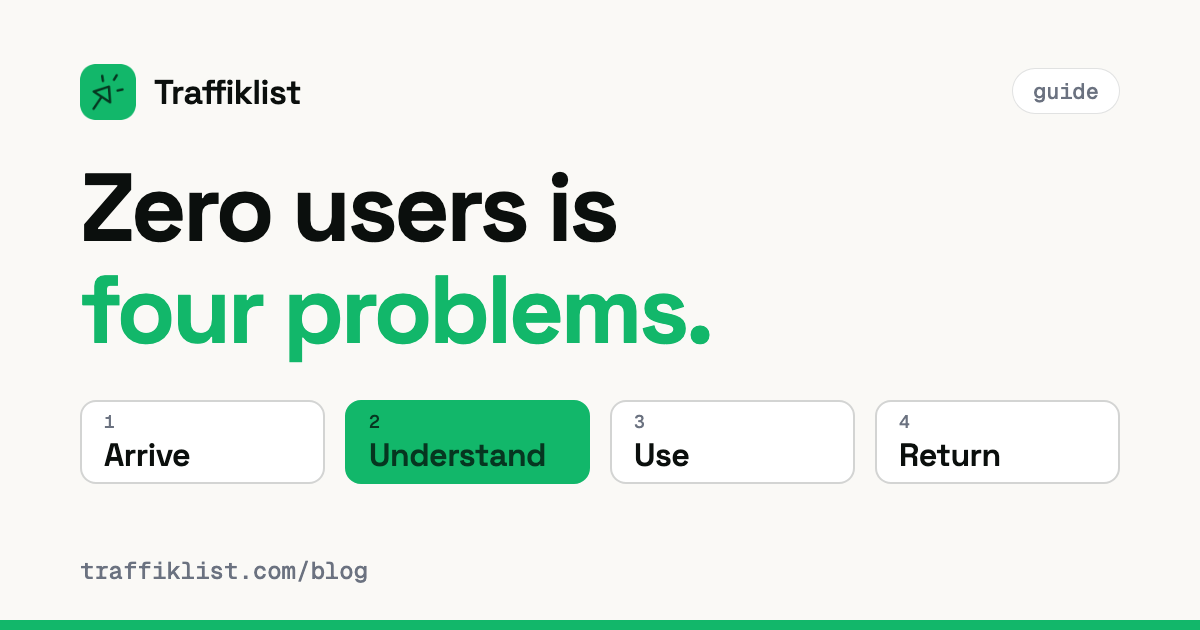
No Users After Launch? Find Which of 4 Stages Is Empty
No users after launch? Zero is a missing number, not a verdict. Find which of four stages is empty and fix just that one. A diagnosis for makers.
Oct 18, 2026 · 15 min read
 Guides
Where to Promote a SaaS in 2026: A Prioritized Playbook
Where to promote a SaaS with no audience: free listings first, launches in sequence, Product Hunt last. A ranked order of operations for bootstrapped makers.
Oct 10, 2026 · 19 min read
 Guides
SaaS Launch Traffic: The 10-Week Plan That Lasts Past Day 3
SaaS launch traffic is a short spike, not a growth engine. Here is a 10-week plan to build an audience first and turn launch day into lasting signups.
Oct 9, 2026 · 19 min read