Where to Promote a SaaS in 2026: A Prioritized Playbook
Where to promote a SaaS with no audience: free listings first, launches in sequence, Product Hunt last. A ranked order of operations for bootstrapped makers.
 SharyphOct 10, 202618 min read
TL;DR: Where to promote a SaaS with no audience: claim free review and directory listings first, launch in sequence (BetaList, small boards, Show HN), and save Product Hunt for last, only with a warm audience. Listings keep paying for months. Launch days don't. Judge every channel by paid conversions, not upvotes.
You finished the product. On launch day you paste the same post into eleven places, refresh every tab until midnight, and wait.
Wednesday arrives. A handful of upvotes. A badge. A trickle of visitors you can't trace to anything.
If you're wondering where to promote a SaaS when you have no audience, start here: launch day isn't a channel. It's one afternoon, and afternoons end.
What keeps working after the spike is quieter: review profiles, directory listings and marketplace pages that people (and AI assistants) read months later. In a March 2026 survey of 1,076 B2B decision makers, G2's 2026 AI Search Insight Report found that 51% now start their software research with an AI chatbot more often than Google.
So this playbook flips the usual order. Listings first. Launches in sequence. Product Hunt last.
I built it from a research pass on where small software teams can actually promote in 2026. Where a number comes from a vendor blog with something to sell, I label it "directional".
It's for solo makers and tiny teams shipping SaaS, dev tools, plugins or AI products, with little audience and a budget close to zero. If you have a funded launch with a PR agency, parts will still help, but it isn't built for you. Updated October 2026.
Why does launch day fail most bootstrapped SaaS makers?
Launch day is one afternoon, and most bootstrapped makers have no audience to fill it. Five beliefs cost the most: treating Product Hunt as the launch, posting everywhere at once, expecting small boards to drive growth, skipping review sites, and treating Reddit and Hacker News as ad space. Each is fixable with a different order of operations.
Five beliefs I see over and over. Each one is expensive.
"Product Hunt is the launch"
Product Hunt is still the biggest single launch day. But since early 2024, the homepage is picked by editors against four published criteria: useful, novel, high craft and creative (Entrepreneur's Insights summary).
Third-party analyses estimate that only about 10% of launches are now Featured, down from 60% or more before. Featured launches reportedly bring 1,000 to 5,000 visitors, versus 100 to 500 for the rest (Shno).
Product Hunt doesn't publish these rates, and the sources are launch-tool vendors. Directional, not audited.
Most of the outcome is decided by an editorial call you don't control. Without an audience of your own, it's a lottery ticket.
"Post everywhere on the same day"
Eleven launches in one day means eleven half-efforts, no time to answer comments, and no chance to fix what breaks. Spread them out and each gets your full attention.
"The small launch boards will grow my product"
They won't, at least not much. One founder's side-by-side comparison on Tetriz is typical: Uneed, 40 upvotes at 3rd place. Fazier, 38 upvotes at 5th. Peerlist, 76 upvotes at 12th, with 561 views.
That's useful for a rehearsal and a few backlinks. It's not a growth engine. I'll show you how to use them for what they're good at in Step 6.
"Review sites are for enterprise software"
On January 29, 2026, G2 announced it would acquire Capterra, Software Advice and GetApp from Gartner. The deal reportedly closed on February 5, 2026 (Wikipedia).
The combined group says it has about 6 million verified reviews, reaches 200+ million annual software buyers and serves 10,000+ vendors. Basic listings stay free.
Those sites feed AI answers. A Semrush study of 230,000 prompts found Reddit and LinkedIn among the five most-cited domains on ChatGPT, Google AI Mode and Perplexity, and G2 is a leading software-review source in those answers too.
Ignoring review sites because "they aren't for small companies" keeps you invisible to buyers who ask a chatbot first.
"Reddit and Hacker News are free ad space"
They're free. They aren't ad space. Hacker News's own rules say a Show HN must be something people can try, and they list blog posts, sign-up pages, newsletters and landing pages as off topic.
Reddit moderators enforce limits that vary by community. One third-party guide reports that r/SaaS allows about one self-promotion every 60 days, so read each sidebar before you post.
Communities reward people who show up and help. They punish people who show up to promote.
Where should you promote a SaaS first?
Start with the free foundations: a prep kit, review and directory profiles, your platform's marketplace, and building in public 6 to 12 weeks early. They cost almost nothing, keep paying for months, and give your later launch spikes something credible to point at. Do this in roughly weeks -12 to -4 before launch.
Phase 1 is the cheap part, and it's the part that keeps paying.
Step 1: Build the prep kit
What to do. Before you touch a single platform, get these eight things ready:
- A demo GIF or short video
- 3 to 5 clean screenshots
- A tagline of about 60 characters
- A short maker story (why you built it)
- A free trial or a demo people can try without signing up
- UTM-tagged links, one per channel
- Infrastructure that survives a traffic spike
- Written answers to the questions you'll get asked
Why it works. Every platform asks for the same assets, so having them ready means you can submit to ten places in an afternoon. The no-signup demo matters most, because Show HN requires that people can try the thing and visitors everywhere bounce off a form.
Example. A UTM link per channel, so analytics shows where every visitor came from:
https://yoursite.com/?utm_source=showhn&utm_medium=launch&utm_campaign=oct-2026Common mistake. Skipping the "survives a traffic spike" check. A good Show HN can send thousands of visitors in hours. If your server falls over, you get one shot and it's gone.
Step 2: Claim the review and directory profiles
What to do. Create free profiles on:
- G2. Free to list. It carries strong weight in AI answers.
- Capterra. One profile also syndicates to GetApp, and G2 now owns both. Free listing, free review responses.
- AlternativeTo. Free. The free queue can take months, but people searching "alternative to X" arrive with buying intent. Links are reportedly nofollow, so treat it as traffic, not SEO.
- SaaSHub. Free, with a dofollow link reported after a review of 1 to 5 days.
Then start a review-request process the day you have your first happy customers. Ask at the moment of success, right after they get a result, not three months later.
Why it works. These pages rank for "best [category] software" and "[competitor] alternatives", and they're what AI assistants quote. One well-run review program now feeds most of the market, because four major sites share an owner.
Example. A review request that gets answered:
Hi [name], you just [specific result they got]. That's the thing I
built [product] for. Would you leave a short review on G2? It takes
about 3 minutes and helps other [type of maker] find it:
[link]

Reply if anything's unclear. I read every one.
Common mistake. Paying too early. Capterra's pay-per-click placement is reportedly about $2 per click with roughly a $500 monthly minimum, and G2's Starter tier is reportedly $299 a month or $2,999 for the first year (Blastra). Don't pay for either until your trial-to-paid funnel converts.
Step 3: List where buyers already search
What to do. If your product plugs into a bigger platform, list it in that platform's marketplace. This is often your best channel, because people there are already looking to buy. Here's where things stand as of October 2026:
- Shopify App Store. 0% revenue share on your first $1M of lifetime gross app revenue earned since January 1, 2025, then 15% (Shopify).
- Atlassian Marketplace. From January 1, 2026, eligible Forge earnings carry 0% revenue share up to $1M in lifetime Forge revenue (Atlassian). Build on Forge, not Connect.
- Chrome Web Store. One-time $5 developer fee, no revenue share (ExtensionBooster).
- Zapier App Directory. Free. After launch you're enrolled in the Partner Program, a strong second channel for any B2B product with an API.
Why it works. A marketplace listing puts you in front of people mid-search, inside the tool they already use. No launch day required.
Common mistake. Assuming the old fee structure still applies. Several of these changed in 2025 and 2026, so check the primary page.
Step 4: Start building in public 6 to 12 weeks early
What to do. Pick one place (X or LinkedIn) and share what you're building: metrics, lessons, demos, screenshots of what broke. Do it before launch, not after. I'd aim for a few posts a week.
Why it works. This is the audience that later powers a Product Hunt launch, and it's the only part of the plan you can't buy or shortcut. LinkedIn is also among the most-cited domains in AI answers (Search Engine Land), so a founder post there does double duty for B2B products.
Common mistake. Announcing the launch to people who've never heard from you. A cold audience gets a cold launch, so keep a simple list of everyone who engages and message them on launch day.
In what order should you run your launches?
Run them one at a time over about seven weeks: BetaList for a waitlist, the small boards as a rehearsal, Show HN for technical attention, then Product Hunt last and only if you've earned the audience. Give each its own day. Each launch teaches you something the next one needs.
If you want the full version of this sequence, I laid it out in my 10-week SaaS launch plan.
Step 5: BetaList (weeks -6 to -4)
What to do. Submit to BetaList before you launch, with a landing page that collects waitlist signups.
Rules. The product must be new, a tech startup, with its own landing page (no template subdomains like vercel.app). Reports on cost conflict, so check the price at checkout.
Common mistake. Submitting a page with no way to sign up. The only point of BetaList is the waitlist.
Step 6: The small-board batch (weeks -2 to 0)
What to do. Submit to the small launch boards: Uneed, Peerlist Launchpad (one launch per week), Fazier, DevHunt if you're building a dev tool, plus Microlaunch, StartupBase and Launching Next. Mostly free. Batch them into the same fortnight.
Why it works. Remember the Tetriz numbers: tens of upvotes, a few hundred views at best. So don't use these boards for traffic. Use them as a rehearsal, where you find the typo in your tagline, the broken signup step, the screenshot that confuses people.
Each board also gives you a backlink. My free launch plan walks through the same boards week by week.
Where Traffiklist fits. Traffiklist is one of these boards, and yes, I built it, so weigh that accordingly. It's a weekly board: new listings show in random order for the first 48 hours, then upvotes decide.
A free listing gets a permanent page, full click tracking by source, and a do-follow backlink once you have 3 upvotes and the Traffiklist badge verified on your site. To go live free, you upvote 5 other products first.
If you'd rather not leave placement to chance, there are the Featured plans. It's a one-time purchase that pins your product in the top 5 for your launch week and guarantees a spot in that week's Featured This Week newsletter to 18,000+ subscribers. It buys placement, not votes, and it doesn't promise customers or a number of clicks.
Common mistake. Buying upvotes, or paying for "submit to 100+ directories" bundles. Every platform detects and penalizes vote buying, and most low-authority directories bring nothing and can look spammy. Pick 20 to 30 relevant ones by hand.
Step 7: Show HN (launch week)
What to do. Post a Show HN on a Tuesday, Wednesday or Thursday US morning, and stay in the thread all day.
Why it works. It's free and can send a large technical audience in hours. Results are highly variable, but a front-page post can bring tens of thousands of visitors.
The rules, in plain words. A Show HN has to be something you've made that others can "play with", per HN's guidelines as summarized by LaunchIt. Blog posts, sign-up pages, newsletters and landing pages are off topic, and asking friends to upvote is prohibited.
The HN FAQ warns that voting rings and canvassing get detected and flagged. Use your personal username, not your brand, and repost only for a major new version.
Example. A plain title and a backstory comment:
Show HN: [Product], [what it does in plain words]

Hi HN, I'm [name]. I built this because [specific problem I had].

What it does: [two plain sentences].
You can try it without signing up here: [link].
What I'd love feedback on: [one specific question].
Common mistake. Posting a landing page. If people can't try it in under a minute, don't post it.
Step 8: Product Hunt, last
What to do. Launch on Product Hunt only if you have a warm audience. I'd want roughly 200 people who already know you and will show up. Pick a Tuesday to Thursday slot starting at 12:01 AM Pacific, and have a demo video ready.
Why it works. Product Hunt is the biggest single launch day, and a Featured launch is the best-case outcome in this whole playbook. Several 2026 guides agree that comments and maker replies now matter more than raw upvotes.
What not to do.
- Don't edit the live page. Editing can reset trending scores, according to a Waitlister-sourced checklist.
- Don't ask directly for upvotes. It can get a launch demoted.
- Don't trust the specific algorithm weights some guides publish ("one comment equals 40 upvotes"). That's vendor speculation, and Product Hunt hasn't published any of it.
If you don't have the audience yet, that isn't failure. Skip it this round, keep building in public, and come back.
How do you keep a SaaS promotion compounding?
Keep showing up where your buyers talk: help in three to five niche communities, keep your product description identical across every listing so AI systems describe you consistently, and add paid channels only after revenue exists. This is week one onward, and it's where the foundation work pays off.
Phase 3 is quieter than a launch and worth more.
Step 9: Participate, don't post
What to do. Spend your time in 3 to 5 niche subreddits, on Indie Hackers, and in Hacker News threads beyond your own. Help first. Mention your product rarely, and always say you built it.
Reddit rules vary by community. From third-party guides (ReplyGenius, Redship):
- r/SaaS reportedly enforces one self-promotion per 60 days, covering posts, comments and product mentions
- r/startups allows no standalone self-promotion
- r/SideProject, r/microsaas and r/AlphaAndBetaUsers are more welcoming
- Many subreddits require 50 to 500 karma and 30 to 90 days of account age
Rules change often, so read the sidebar. Also look past founder subreddits: where your customers hang out (r/webdev for dev tools) often converts better than places where everyone is selling.
Indie Hackers is free, and spun out of Stripe in March 2023 (Indie Hackers). Build-in-public posts with real numbers work. Bare product links don't.
Common mistake. Fake second accounts, undisclosed founder posts, or cross-posting the same promo to six subreddits. All three get you banned, and bans on Reddit follow your account.
Step 10: AI directories and AI citations
What to do. If AI is core to your product, list on the AI directories. There's An AI For That is the largest, with around 50,000 tools indexed. Pricing has changed often, so check its Get Featured page at checkout. Hundreds of "AI directories" exist mainly to sell backlinks, so stick to the few with real traffic.
Then work on being cited. For every AI assistant, the playbook is the same:
- Keep your product description identical across G2, Capterra, AlternativeTo and Crunchbase
- Publish comparison and "alternatives" pages on your own site
- Earn real Reddit mentions (see Step 9)
- Once a month, ask ChatGPT and Perplexity "best [your category] tools" and note whether you appear
Why it works. AI answers are now a front door. Backlinks and listings can help with that (my guide to backlinks for a new website covers the free routes), but treat any promise that a directory "guarantees" AI visibility as a red flag.
Date-stamp warning. This changes fast. The Semrush study found ChatGPT cited Reddit in close to 60% of responses in early August 2025, then about 10% by mid-September 2025 after a change on the platform's side. What I'm describing is October 2026, so re-check before you lean on it.
Step 11: Paid, only once revenue exists
What to do. Add paid channels one at a time, after you can measure what they return.
- Newsletter sponsorships. Niche beats big. A few thousand subscribers in your exact segment usually costs less per signup than a large generic list. On Paved, the average cost per click on its most re-booked sponsorships was about $5.
- Lifetime-deal sites (AppSumo and others). Cash and feedback, with strings. The revenue split is negotiated per deal, so read the partner terms yourself. Payouts run Net 60 (AppSumo).
Lifetime buyers pay once and expect support forever, and the deal fixes your price low in buyers' minds. If you do one, cap the features per tier and plan your support time.
How do you know which channel worked?
Tag every link with UTMs and track visitors, signups, activated users and paid customers by source. Check referral traffic again at 30 and 90 days, because listings and review profiles pay late. Judge each channel on paid conversions, not upvotes. An upvote is a compliment. A click is a fact.
Here's the part most launch guides skip. After all that effort, how do you know which channel paid off?
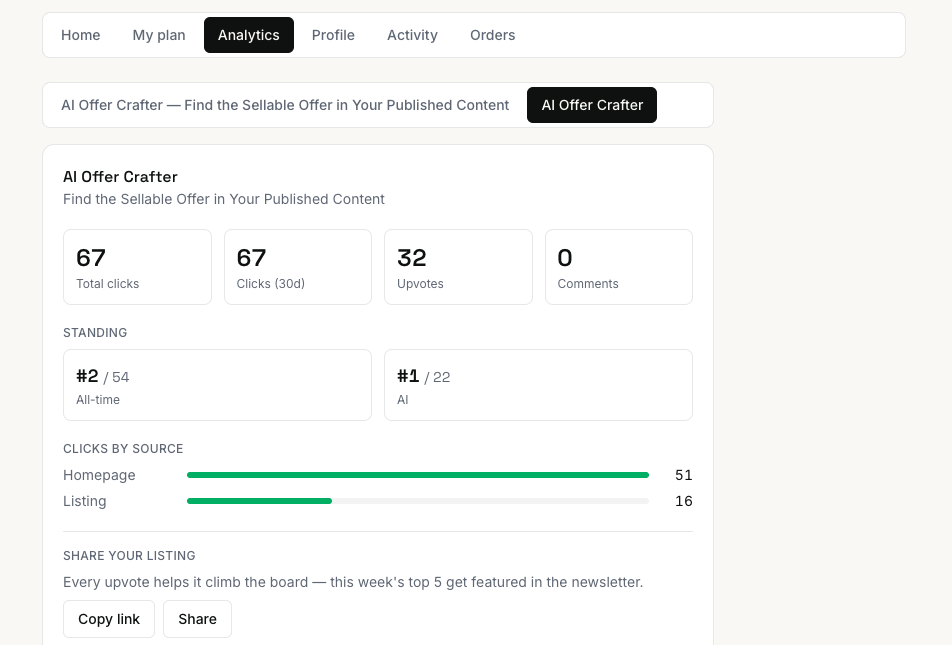
One listing's dashboard: 67 clicks, 51 from the homepage and 16 from the listing page. A count of who clicked and from where, not a badge.
This is what "proof, not promises" looks like. Not upvotes. Not a badge. A count of how many real people clicked, split by where they came from.
Whatever boards you use, build the same view for yourself:
- UTM-tag every link (Step 1), one per platform
- Track the funnel by source: visitors, then signups, then activated users, then paid
- Check referral traffic again at 30 and 90 days
A paid conversion is the only thing that pays your rent.
Frequently asked questions
Where should I promote a SaaS with no audience?
Start with free review and directory profiles (G2, Capterra, AlternativeTo, SaaSHub) and your platform's marketplace. Then launch in sequence, with BetaList and the small boards first and Product Hunt last. Building in public 6 to 12 weeks early is the only way to earn the audience that makes the later launches work.
Is Product Hunt still worth it in 2026?
Yes, but only with a warm audience and a polished product. Homepage placement is now an editorial decision, and third-party analyses estimate only about 10% of launches get Featured. If you don't have an audience yet, build one first and launch last.
How do I get on Hacker News without getting flagged?
Post something people can try right now, not a landing page. Use a plain title, add a short backstory comment, use your personal account, and never ask anyone to upvote. Stay in the thread to answer questions.
Do directory backlinks help SEO or AI search?
They can help. Listings on review sites and directories get read by search engines and cited in AI answers. But nofollow links (AlternativeTo's, for example) pass less SEO value, and nobody can promise AI visibility, so treat the backlinks as a bonus and the traffic as the point.
Should I pay for G2 or Capterra?
Not at first. Free profiles and a steady review process do most of the work. Test paid placement (Capterra PPC reportedly starts around $2 a click, with about a $500 monthly minimum) only once your trial-to-paid funnel converts.
Key takeaways
- Claim free G2, Capterra, AlternativeTo and SaaSHub profiles first, and keep one identical product description across all of them.
- List in your platform's marketplace (Shopify, Atlassian, Chrome, Zapier) and check each fee on its primary page.
- Space your launches out: BetaList, then the small boards, then Show HN, each on its own day.
- Launch on Product Hunt only with roughly 200 warm supporters, and never ask for upvotes.
- Tag every link with UTMs and judge each channel by paid conversions at 30 and 90 days.
What to do next
Pick the level you're ready for.
- Read. Bookmark this and work through the steps over the next few weeks.
- Try one thing this week. Claim your G2 and AlternativeTo profiles. It takes an afternoon and keeps paying.
- Submit. Submit your product, free and see exactly how many people clicked.
- Upgrade (optional). If you want a guaranteed placement instead of a lottery ticket, see the Featured plans in Step 6.
Hit reply and tell me what you're building. I read every one.
Sharyph
P.S. Updated October 2026. Platform rules and prices in this space change monthly, so check each platform's checkout or terms page before you commit. And if this helped, send it to a maker who's about to launch on a Tuesday with no plan.
More from the blog
 Guides
SaaS Launch Traffic: The 10-Week Plan That Lasts Past Day 3
SaaS launch traffic is a short spike, not a growth engine. Here is a 10-week plan to build an audience first and turn launch day into lasting signups.
Oct 9, 2026 · 19 min read
 Guides
Launch a Side Project for Free in 2026: A 6-Week Plan
Launch a side project for free in 2026: a six-week sequence covering the channels that still work, what now costs links or time, and realistic traffic.
Oct 5, 2026 · 14 min read
 Guides
Market a New App Without Ads: The 2026 90-Day Playbook
How to market a new app without ads: a 90-day plan covering audience, communities, AI search, directories and referral loops, backed by 2026 data.
Oct 5, 2026 · 30 min read